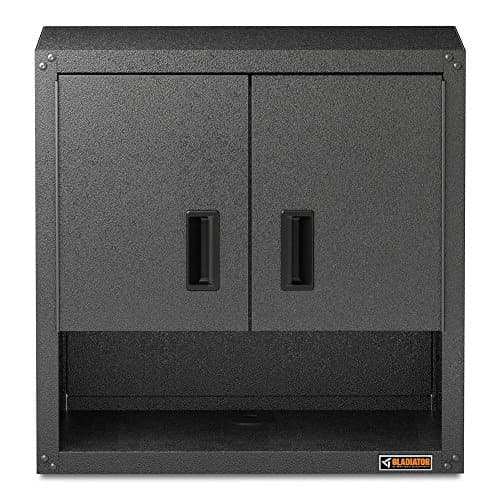
Garage cabinets are the most searched product in this category by a wide margin, and the hardest to compare, because the specification that decides whether a cabinet stays square for fifteen years is the one most manufacturers decline to publish.
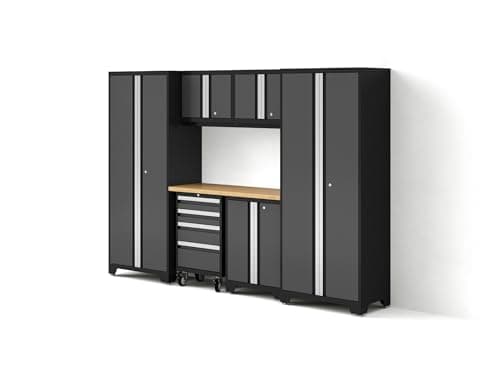
Start with steel gauge, if you can find it. Gauge is an inverse scale: a smaller number is thicker steel. 24-gauge is roughly 0.024 inches; 20-gauge is roughly 0.036 inches, half again as thick. It governs how much the carcass flexes when a loaded cabinet is dragged across a floor, whether the door stays aligned after the frame takes a knock, and how a shelf behaves at the top of its rated load. NewAge publishes it — 24-gauge on the Bold Series, with 20-gauge shelves on the Bold XL. Gladiator, the brand most people picture when they picture a garage cabinet, publishes no gauge for its Ready-to-Assemble range anywhere we could find. That is not a small omission. It means the most recognizable cabinet in the category cannot be compared on construction against a cabinet that tells you.
Then read the capacity figures as a pair, not a single number. Manufacturers publish two: a total per cabinet, and a limit per shelf. The per-shelf figure is the one that governs daily use, because you load a cabinet a shelf at a time and nobody distributes weight evenly across four shelves on purpose. The spread here is wider than the marketing suggests. Gladiator's Large GearBox publishes 450 lb per unit and 75 lb per shelf. NewAge's Bold Series publishes 600 lb per base cabinet and 200 lb per shelf — nearly three times as much per shelf, on a cabinet in the same market segment. If you are storing a car battery, a bench grinder and a case of oil on one shelf, that difference is the entire decision.
Welded or flat-pack is a real trade, not a quality ranking. A fully welded cabinet arrives square and stays square: there is no assembly step for you to get wrong, and the joints are not relying on your torque on a bolt. It is also extremely heavy, awkward through a standard door, and impossible to adjust once it is in place. Flat-pack ships in boxes a person can carry, goes together in an afternoon, and can be fitted into a finished garage where a welded unit simply will not turn a corner — but its final squareness is your work, not the factory's. NewAge ships welded; Gladiator ships ready-to-assemble. Choose on your garage's access, not on which sounds more premium.
Depth is the specification people regret. Most garage cabinet ranges are 18 inches deep. That is fine for hand tools, paint and consumables, and it is too shallow for a miter saw, a compressor, or anything with a footprint designed for a workshop rather than a closet. The deeper 24-inch lines exist for exactly this reason. Before you buy, measure the deepest thing you intend to put away — and then measure your garage, because 24 inches of cabinet on a side wall takes a real bite out of the space a car door needs to open.
On the store brands. Husky at Home Depot and Kobalt at Lowe's are frequently the best price per linear foot of steel cabinet in the country, and we cannot link either one — they are store exclusives and we have joined no program that covers them. We cover them anyway, and we say plainly that they are often the value answer, because a comparison that quietly omits the cheapest credible option to protect a commission is not a comparison. We earn nothing whichever way you go on those two.
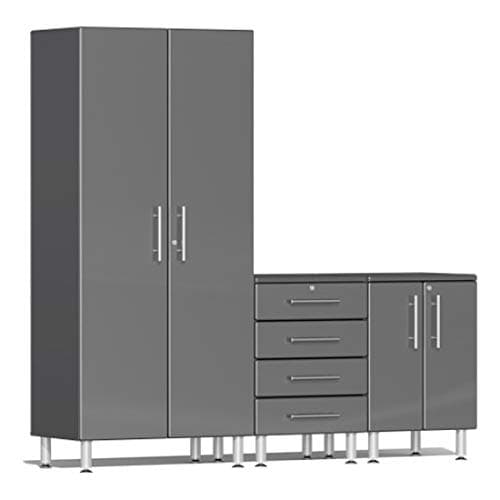
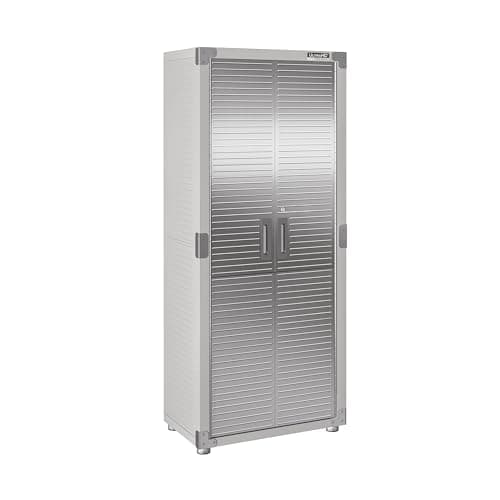
Sets versus single units. The premium ranges are sold as sets, which is the right answer if you are doing a whole wall at once and the wrong one if you are not. Seville Classics is the exception worth knowing about: UltraHD sells as individual cabinets, so a wall can be built up one purchase at a time and the units still match. It publishes a per-shelf figure on its 30-inch cabinet and — oddly — not on the 60-inch model that costs considerably more, which is the sort of thing worth checking per unit rather than per brand.
Below: the ranked roundup, the head-to-heads that come up most, the single-brand deep dives on the five ranges people actually shortlist, and the install and dimension guides that decide whether what you buy actually fits.