Metal garage cabinets
Five specifications decide this purchase. Two of them are frequently not published.
#ad We earn a commission if you buy through this link, at no extra cost to you. How this site is funded. Prices last checked October 16, 2026.
Quick picks
The steel cabinets that publish the most about how they are built, in the order we would consider them.
| # | Product | Best for | Published rating | Buy |
|---|---|---|---|---|
| 1 | 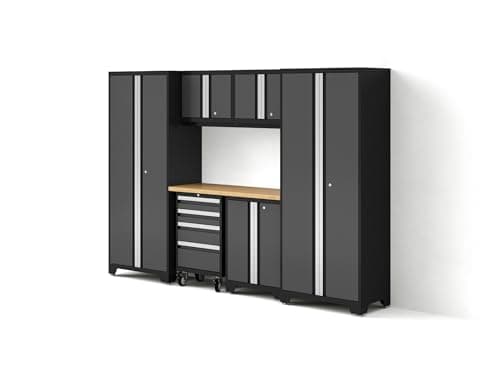 Best documented NewAge Bold Series Garage Cabinet Set 24 gauge, welded, 200 lb shelves — all published. | A full wall run where you want published construction specs | 600 lb totalManufacturer | |
| 2 | 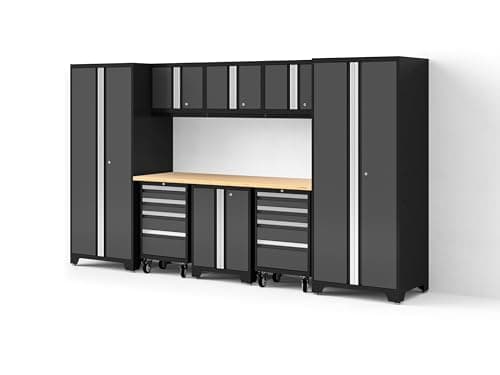 Best for depth NewAge Bold XL Series Garage Cabinet Set 24 inches deep with 20-gauge shelves. | Deeper storage — a garage that holds real power tools | 700 lb totalManufacturer | |
| 3 | 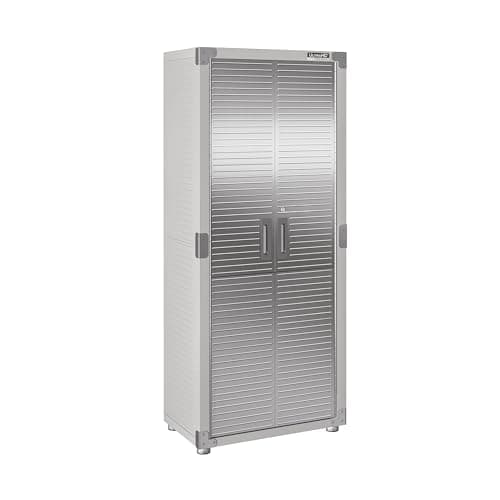 Best incremental buy Seville Classics UltraHD Storage Cabinet Powder-coated steel sold as single units. | Adding one cabinet at a time instead of committing to a full wall | 750 lb totalRetailer listing | |
| 4 | No photo Best flat-pack, when stocked Gladiator Ready-to-Assemble Large GearBox Flat-packed and 450 lb per unit, but out of stock on Amazon today. | Matching an existing Gladiator wall system for a consistent look | 450 lb totalManufacturer |
#ad We earn a commission if you buy through this link, at no extra cost to you. How this site is funded. Prices last checked October 16, 2026.
Steel is the default for garage cabinets and mostly the right one. But “steel” covers a wide range of construction, and only two of the five specifications that actually matter are reliably published.
1. Steel gauge — the one that matters most
Gauge runs backwards: a smaller number is thicker steel. 24-gauge is roughly 0.024 inches, 20-gauge roughly 0.036 — half again as thick.
It governs three things you will notice:
- Carcass rigidity. How much the box twists when a loaded cabinet is dragged, which is what pulls doors out of alignment.
- Shelf deflection. How much a shelf bows at rated load, and whether it recovers when you take the weight off.
- Dent resistance. How the panel takes a knock from a car door or a dropped tool.
24 vs 20gauge
NewAge publishes 24-gauge frames with 20-gauge shelves on its XL range — thicker steel where the concentrated load is. That is both good practice and more disclosure than most of the category offers. Gladiator publishes no gauge for its cabinets at all.
2. Welded or flat-pack
A trade, not a quality ranking. Welded arrives square and stays square, with no assembly step you can get wrong — and is heavy, rigid, and may not physically fit the route into a finished garage. Flat-pack ships in boxes one person can carry, costs less to freight, and its final squareness is your work.
Decide this on your garage’s access, not on which sounds more premium. Measure door widths and turns before you order.
3. Per-shelf capacity, not per-cabinet
Manufacturers publish both, and the per-cabinet number is the one they lead with. It is the less useful of the two, because nobody distributes weight evenly across four shelves on purpose. You put the heavy things on one shelf.
The published spread on this site is wide: 55 lb (Gladiator modular wall cabinet), 75 lb (Gladiator Large GearBox), 200 lb (NewAge Bold), 250 lb (NewAge Bold XL base). Check the per-shelf figure and ignore the headline.
4. Depth
Eighteen inches is the category standard and it is too shallow for real power tools. Twenty-four inches is what a miter saw or a compressor needs. The trade is floor space, and in a single-car garage six extra inches across a wall can be the difference between opening a car door and not.
Measure the deepest thing you intend to store, then tape the cabinet footprint on the floor and open the car door inside it. Standard dimensions are here.
5. Finish
Powder coat is the standard and it is good until it is breached. A deep scratch to bare metal in a damp garage will corrode, and it will do it from the inside where you do not see it until the paint lifts.
Two things help more than the coating specification does: keep the cabinet off the concrete slab, because concrete wicks moisture continuously; and touch up scratches when they happen rather than when they rust.
What to actually check before buying
A buying checklist rather than a product ranking. The third column is the useful one.
| Specification | What good looks like | Who publishes it |
|---|---|---|
| Steel gauge | 24 ga carcass, 20 ga shelves | NewAge. Not Gladiator. |
| Construction | Welded, if it fits through the door | Both, clearly |
| Per-shelf capacity | 200 lb or better | Both, and the gap is large |
| Depth | 24″ for power tools, 18″ otherwise | Both |
| Finish | Powder coat, kept off the slab | Both, in general terms |
Steel that hangs on the wall is rated differently again, in per-shelf figures that describe the box and say nothing about the screws holding it up. The wall-hung cabinets are compared on that point in best wall mounted garage cabinets. And the tall lockable boxes, where two sellers publish a steel thickness in millimeters and the national brands publish a gauge, are ranked in best garage storage lockers.
Common questions
What gauge steel is best for garage cabinets?
Do metal garage cabinets rust?
How deep are standard garage cabinets?
Sources
- NewAge Bold XL — 24-gauge frame with 20-gauge shelves
- NewAge Bold Series support hub — per-shelf capacities
- Gladiator Large GearBox — capacities published, gauge not
Figures were read on the dates shown against each source. If one has changed, or if we have got something wrong, tell us and we will correct the page.
Read next
- CabinetsThe best garage cabinetsSteel gauge, per-cabinet and per-shelf capacity compared across the brands that publish them and the ones that do not.
- CabinetsMetal vs plastic garage cabinetsSteel against resin on capacity, moisture and impact — and the one case where resin is genuinely the right answer.
- CabinetsGladiator vs NewAge garage cabinetsThe head-to-head most buyers end up in, decided on which brand publishes its construction specs.
- CabinetsGarage cabinet systemsWhat the four cabinet classes are rated for, which to buy first, and why piece count is the wrong comparison.
- CabinetsBest wall mounted garage cabinetsSix wall-hung cabinets ranked on published capacity - and on the wall figure that only one listing mentions.
- CabinetsBest garage storage lockersSix lockable steel lockers ranked on published shelf capacity, steel thickness and the anti-tip detail most listings skip.