Garage cabinet systems
Sets are sold by piece count. Cabinets are rated by class. Those two things have almost nothing to do with each other.
#ad We earn a commission if you buy through this link, at no extra cost to you. How this site is funded. Prices last checked October 22, 2026.
Quick picks
Ranked by how completely the manufacturer publishes capacity per cabinet class, then by how easily the system can be bought in stages.
| # | Product | Best for | Published rating | Buy |
|---|---|---|---|---|
| 1 | 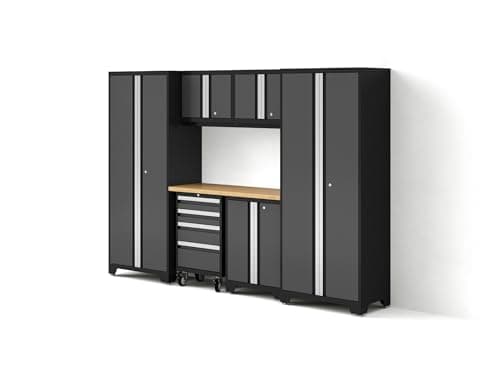 Best documented system NewAge Bold Series Garage Cabinet Set Publishes a separate capacity for lockers, base and wall cabinets. | A full wall run where you want published construction specs | 600 lb totalManufacturer | |
| 2 | No photo Easiest to build up in stages Gladiator Ready-to-Assemble Large GearBox Flat-packed, so a wall can arrive one carton at a time. | Matching an existing Gladiator wall system for a consistent look | 450 lb totalManufacturer | |
| 3 | 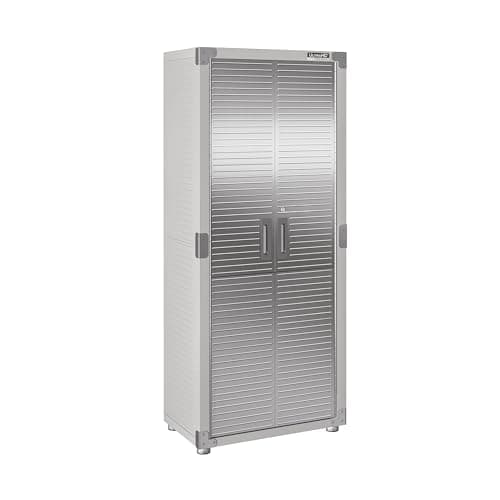 Best bought as single units Seville Classics UltraHD Storage Cabinet Sold individually rather than only as a set. | Adding one cabinet at a time instead of committing to a full wall | 750 lb totalRetailer listing | |
| 4 | No photo The anchor unit Gladiator Premier Pre-Assembled 84" Tall Cabinet 2,000 lb per unit and 24 inch depth, for the heavy end of the run. | One deep, tall cabinet doing the work of two shallow ones | 2,000 lb totalManufacturer | |
| — | No photo We would skip this one Gladiator Full-Door Modular GearBox 55 lb per shelf is too little to justify a slot in a planned system. | One cabinet of enclosed storage at bench height, on leveler legs | 410 lb totalManufacturer |
#ad We earn a commission if you buy through this link, at no extra cost to you. How this site is funded. Prices last checked October 22, 2026.
Search for garage cabinets and what comes back is not cabinets, it is sets: a 4-piece kit, a 6-piece, an 8-piece, a 10-piece. The piece count is the headline number on every listing in this category, and it is close to meaningless. A 6-piece set can be six wall cabinets, or it can be two lockers, two base cabinets, a wall cabinet and a worktop. Those two purchases hold completely different things and cost different amounts per linear foot of wall.
The four classes, and what each is rated for
Every system on the market is assembled from the same four building blocks. Learning them is the whole trick, because manufacturers publish capacity per class and almost never per set.
Class capacities as published by NewAge and Gladiator on their own product and support pages, read 2 September and 4 September 2026.
| Class | Typical job | Published capacity |
|---|---|---|
| Tall locker | Full-height storage for long tools, ladders, bulk consumables | 800–900 lb / unit |
| Base cabinet | Floor-standing storage under a worktop; the working heart of a run | 600–700 lb / unit |
| Wall cabinet | Overhead storage above a bench; limited by the fixing, not the box | 100–410 lb / unit |
| Worktop | The surface that turns cabinets into a bench | Not published — usually rated with the bench, not the set |
Note the wall cabinet row. NewAge publishes 100 lb for its wall cabinets against 600 lb for a base cabinet in the same set, and that is not a quality difference — a wall cabinet is limited by what it is bolted into, and 100 lb is a sane published figure for a box hanging over your head. Gladiator publishes 150 lb per unit and 40 lb per shelf for its 3/4 Door Wall GearBox, the cabinet in its range actually built to hang, and neither brand publishes what fixing those numbers assumes. Fix into studs regardless.
Sets versus single units
Two buying models exist and they suit different people. NewAge, Gladiator Premier and the kit brands sell sets: one order, one delivery, everything matches, and the price per linear foot is usually better than buying the same cabinets individually. The cost is that you commit the whole wall and the whole budget at once, and a set arrives on a pallet.
Seville Classics and Gladiator’s Ready-to-Assemble line sell single units. That is slower and dearer per foot, but it lets you buy a cabinet, live with it for a month, and find out whether you actually wanted 18 inches of depth before you own eight feet of it. For a first garage build this is usually the better answer, and it is the one almost no manufacturer markets.
NewAge Bold Series Garage Cabinet Set
NewAge Products · Bold Series
#ad We earn a commission if you buy through this link, at no extra cost to you. How this site is funded. Prices last checked October 22, 2026.
The cabinet range that publishes the most. NewAge states 24-gauge steel and fully-welded construction on the product page, plus per-cabinet and per-shelf capacities. Gladiator, its closest rival, publishes no gauge at all — and gauge is the single number that separates a cabinet that stays square from one that racks.
- Load distance:
- not stated by the manufacturer, so treat the figure as a flat-against-the-wall number
- Fastening:
- Base cabinet, total capacity
NewAge publishes a capacity per cabinet type: 800 lb lockers, 600 lb base cabinets, 100 lb wall cabinets.
- Published rating
- 600 lb totalManufacturer
- Per shelf
- 200 lb / shelfManufacturer
- Dimensions
- 180" W x 18" D x 76.75" H (8-piece set)Manufacturer
- Steel gauge
- 24 gauge steel, fully weldedManufacturer
- Thickness
- Not published
- Material
- Not published
- Coverage
- Not published
- Warranty
- Not published
- Publishes steel gauge, which its main competitor does not
- Ships fully welded, so there is no assembly-square to get wrong
- 200 lb adjustable shelves against Gladiator's 75 lb
- 18 inch depth is shallow for larger power tools — the XL range is 24 inch
- Welded cabinets are heavy and awkward to move once placed
NewAge is the only brand here that publishes a separate capacity for each class in the set — 800 lb lockers, 600 lb base cabinets, 100 lb wall cabinets, 200 lb shelves — alongside a 24-gauge welded construction figure. On a purchase that stays bolted to a wall for fifteen years, that disclosure is what you are paying the premium for.
The constraint is delivery. A welded set arrives rigid and heavy, and the route from the curb to the wall decides whether it can be installed at all. Measure the doors, the turns and the step before ordering.
Gladiator Ready-to-Assemble Large GearBox
Gladiator · Ready-to-Assemble Large GearBox
#ad We earn a commission if you buy through this link, at no extra cost to you. How this site is funded. Prices last checked October 22, 2026.
The most recognizable garage cabinet in the US and the one that tells you least about itself. Gladiator publishes 450 lb per unit and 75 lb per shelf but no steel gauge anywhere we could find — so there is no way to compare its construction against a brand that does publish one.
- Load distance:
- not stated by the manufacturer, so treat the figure as a flat-against-the-wall number
- Fastening:
- Per unit
- Published rating
- 450 lb totalManufacturer
- Per shelf
- 75 lb / shelfManufacturer
- Dimensions
- 36" W x 72" H x 18" D, 3 full-width shelvesManufacturer
- Steel gauge
- Not published — this manufacturer does not state one
- Thickness
- Not published
- Material
- Not published
- Coverage
- Not published
- Warranty
- Not published
- Bolts to the Gladiator wall system with an optional bracket kit
- Widely stocked, so replacement parts and matching units are easy to find
- Flat-packed, which makes it far easier to get into a finished garage than a welded unit
- Steel gauge is not published, so construction cannot be compared
- 75 lb per shelf is a third of NewAge's published 200 lb
- Assembly required, and squareness depends on how well you do it
450 lb per unit and 75 lb per shelf, flat-packed into cartons one person can move. That is the whole argument: a system you can extend a cabinet at a time, in a garage a pallet cannot reach.
Gladiator publishes no steel gauge for it, so you are buying on the capacity figure and the accessory ecosystem rather than on construction. The full range is compared in the Gladiator cabinet review.
Seville Classics UltraHD Storage Cabinet
Seville Classics · UltraHD Storage Cabinet
#ad We earn a commission if you buy through this link, at no extra cost to you. How this site is funded. Prices last checked October 22, 2026.
The commercial-grade middle option, and the best documented steel cabinet we can link: 750 lb total and 150 lb per shelf on a 30 by 18 by 72 inch body, behind stainless doors on a three-point lock. Sold as single units rather than a set, so a wall can be built up one cabinet at a time.
- Load distance:
- not stated by the manufacturer, so treat the figure as a flat-against-the-wall number
- Fastening:
- Total, on four leveling feet with rubber base pads
Published as a total weight capacity of 750 lb (150 lb per shelf) for the 30 in. model. Four shelves are supplied, so the published total is larger than four shelves at their own rating.
- Published rating
- 750 lb totalRetailer listing
- Per shelf
- 150 lb / shelfRetailer listing
- Dimensions
- 30" W x 18" D x 72" H exterior; 27" W x 17.13" D x 67.6" H interiorRetailer listing
- Steel gauge
- Not published — this manufacturer does not state one
- Thickness
- Not published
- Material
- Powder-coated solid steel with stainless-steel doorsRetailer listing
- Coverage
- Not published
- Warranty
- Not published
- Publishes a total AND a per-shelf figure, which most steel cabinets do not
- Three-point lock described in detail: top, middle and base, two keys
- Sold as single units, so a wall can be built up over time
- Leveling feet with rubber pads, for a garage slab that is never flat
- Capacities are published per model, not range-wide, so they need checking one by one
- No published steel gauge or thickness anywhere on the listing
- Nothing published about anchoring a 72 inch cabinet to the wall
- Narrower than the budget lockers that cost a third as much
Seville sells UltraHD as individual cabinets rather than only as kits, in widths from 24 to 60 inches and depths of 18 or 24. That makes it the practical answer for building a wall over six months instead of one weekend.
The catch is that Seville publishes capacity per model rather than across the range, so a figure you read on one cabinet does not transfer to the next one along. Check the specific unit before you buy it.
What a system does not include
- Matching cabinets across two or three classes
- A worktop on the larger sets
- Leveling feet, and a wall-anchor bracket on most tall units
- A better price per linear foot than the same cabinets bought singly
- Lag screws and washers sized for your studs - buy these separately
- Any fixing suitable for masonry, which needs a different anchor entirely
- A power strip, lighting, or the outlet the worktop assumes
- Casters, which are frequently a separate kit and change the rating
That last one matters more than it sounds. Several cabinets in this category publish one figure on leveling feet and a different one on casters, and the caster figure is always lower. If mobility is part of your plan, find the caster rating before you buy the caster kit.
How to size the run
Work backwards from the wall, not forwards from the catalog. Measure the usable wall — the part with no door, window, panel box or hose reel in it — and subtract six inches at each end. Divide what is left by the cabinet widths available in the range you like. You will almost always find that the set that fits is one size smaller than the set you wanted, and finding that out on paper is free.
Then check depth against the floor. Eighteen inches is the standard and it is too shallow for a miter saw; 24 inches solves that and takes half a foot more of a one-car garage. The dimensions reference has the class-by-class numbers, and the wall layout guide covers what has to stay reachable once the cabinets are in.
Mixing brands
You can, and for most garages you should. Nothing about a base cabinet from one brand stops it standing next to a locker from another; the only things that genuinely have to match are the wall system, where hooks and brackets are proprietary, and the worktop, which has to span the cabinets it sits on. Colors will differ slightly and heights may differ by an inch. Both matter less than buying the right class of cabinet at the right price.
One range sells its classes the same way but is not made of steel at all. Ulti-MATE Garage 2.0 is a laminated board carcass, and whether that matters depends far more on your garage than on the cabinet.
If the set you are pricing is at the premium end, the published construction figures are compared in premium garage cabinets.
Common questions
What is a garage cabinet system?
How many pieces do I need for a two-car garage wall?
Which cabinet should I buy first?
Can you mix cabinet brands in one run?
Sources
- NewAge Bold Series support hub — per-class and per-shelf capacities
- NewAge Bold XL — 24-gauge frame, 20-gauge shelves, class capacities
- Gladiator Ready-to-Assemble Large GearBox — 450 lb/unit, 75 lb/shelf
- Gladiator Full-Door Modular GearBox — 410 lb/unit on leveler legs, 55 lb/shelf
- Gladiator Premier 84" Tall Cabinet — 2,000 lb/unit, 400 lb/shelf
- Seville Classics UltraHD storage cabinet range — sizes sold as single units
Figures were read on the dates shown against each source. If one has changed, or if we have got something wrong, tell us and we will correct the page.
Read next
- CabinetsThe best garage cabinetsSteel gauge, per-cabinet and per-shelf capacity compared across the brands that publish them and the ones that do not.
- Planning & installLaying out a garage wallZoning by frequency, working around the obstructions every garage has, and the test that prevents expensive mistakes.
- Planning & installStandard garage cabinet dimensionsDepths, widths, heights and clearances, with the published figures from two manufacturers' actual sets.
- CabinetsUlti-MATE garage cabinetsThe only non-steel cabinet range we cover, with a published shelf rating that beats most of the steel ones.
- CabinetsGarage cabinets with drawersDrawer cabinets ranked on the per-drawer figure most makers leave out, and what a drawer of tools actually weighs.
- Planning & installBest garage organization systemFour brand ecosystems ranked on coverage and disclosure, for buyers choosing a system rather than a product.
- CabinetsPremium garage cabinetsUpgrade-tier cabinet ranges compared on published gauge, weld and warranty - the things capacity figures do not tell you.