How much weight can slatwall actually hold?
Nine published ratings, four different units, and the two qualifiers almost nobody prints next to the number.
#ad We earn a commission if you buy through this link, at no extra cost to you. How this site is funded. Prices last checked October 17, 2026.
Quick picks
The two systems that come out of this table best: one publishes what its rating means on a bracket, the other has the highest flat number.
| # | Product | Best for | Published rating | Buy |
|---|---|---|---|---|
| 1 | No photo The only at-distance figure storeWALL Heavy Duty Slatwall Panels 300 lb at the panel face, 165 lb four inches out. | Anyone hanging shelves and brackets, not just hooks | 300 lb / sq ft165 lb at 4″ outManufacturer | |
| 2 | No photo Highest flat rating Proslat ProCore Slatwall 200 lb/sq ft, at a wider 24 inch stud spacing. | Shelf runs and heavy hanging loads on the same wall | 200 lb / sq ftInstall doc | |
| 3 | 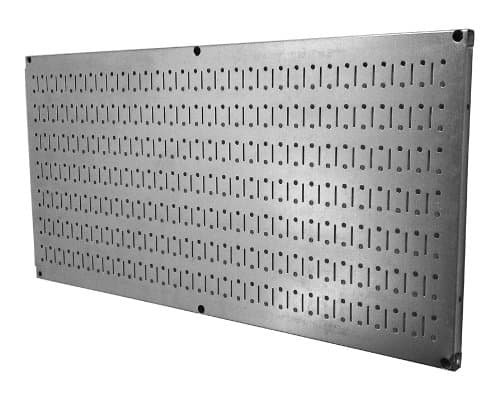 Best documented overall Wall Control 16in x 32in Metal Pegboard Panel Two mounting ratings plus published per-hook limits. | Hand tools you want to rearrange often, on any wall | 200 lb / panelInstall doc |
#ad We earn a commission if you buy through this link, at no extra cost to you. How this site is funded. Prices last checked October 17, 2026.
This page exists because of something we noticed while trying to answer a simple question. Two manufacturers — Proslat and Trusscore — both publish “75 lb per square foot” for their PVC slatwall. Identical numbers, different products. And neither states what that number assumes.
That is the whole problem in miniature. A load rating without a stated load distance and a stated fastening method is not a specification. It is a number, and you cannot design a wall around it.
The published ratings, as printed
Every figure below was read from the manufacturer’s own page or FAQ on 2 September 2026 and is linked so you can check it. Note the Unit column before you compare anything: there are four different units in this table, across products a buyer chooses between in a single afternoon.
One whole product class is missing from the table for the simplest possible reason: wire gridwall publishes no rating to put in it. Not one gridwall panel or hook we could find states a weight figure, which is why it is handled separately in slatwall vs gridwall rather than ranked here.
Published load ratings for garage wall systems, exactly as the manufacturers print them. Nothing here is converted yet.
| System | Published rating | Unit | At distance? | Fastening stated? |
|---|---|---|---|---|
| Proslat PVC Slatwall | 75 | lb / sq ft | Not published | Yes — 1½″ #8 pan head, 16″ studs |
| Proslat ProCore | 200 | lb / sq ft | Not published | Yes — 24″ stud spacing |
| storeWALL Heavy Duty | 300 / 165 | lb / sq ft | Yes — 4″ | Yes — HD InstallStrips |
| storeWALL Standard Duty | 250 / 115 | lb / sq ft | Yes — 4″ | Yes — SD InstallStrips |
| Trusscore SlatWall | 75 | lb / sq ft | Not published | Not published |
| Flow Wall | 100 | lb / sq ft | Not published | Partial — substrates named |
| Gladiator GearWall | 50 | lb / sq ft | Not published | Not published |
| Gladiator GearTrack | 75 | lb / LINEAR ft | Not published | Bare studs, or drywall over studs |
| Wall Control pegboard | 200 / 100 | lb / PANEL | Base-of-hook stated | Yes — studs vs drywall anchors |
Normalizing the units: the Gladiator arithmetic
Look at the two Gladiator rows again. GearWall is rated 50 lb per square foot. GearTrack — a rail sold on the adjacent page of the same website — is rated 75 lb per linear foot. Most readers will assume the rail is roughly 1.5x the panel. It is not.
A GearTrack channel is 6 inches high. One linear foot of it therefore occupies 12 inches wide by 6 inches tall, which is half a square foot of wall. So:
150lb / sq ft equivalent
Gladiator GearTrack, normalized. 75 lb per linear foot ÷ 0.5 sq ft of wall = 150 lb per square foot — three times the GearWall panel sold beside it, from the same manufacturer. The change of unit hides the entire difference.
That is not a criticism of Gladiator’s engineering; the rail genuinely is the stronger product and it is priced accordingly. It is a criticism of the presentation. A buyer comparing “50” against “75” on two adjacent product pages will conclude the rail is marginally better. It is triple.
The Wall Control figure needs the same treatment. A Wall Control panel is 16 by 32 inches, which is 512 square inches, or 3.56 square feet. So its 200 lb per panel into studs normalizes to about 56 lb per square foot, and its 100 lb into drywall anchors to about 28 lb per square foot. Suddenly the steel pegboard and the entry-level PVC slatwall are in the same conversation — which the raw numbers, 200 against 75, completely obscured.
The same nine products with every rating converted into one unit. This is our arithmetic, not the manufacturers' — the working is shown so you can check it.
| System | As published | Normalized to lb / sq ft | Basis |
|---|---|---|---|
| storeWALL Heavy Duty | 300 lb / sq ft | 300 (165 at 4″) | As published |
| storeWALL Standard Duty | 250 lb / sq ft | 250 (115 at 4″) | As published |
| Proslat ProCore | 200 lb / sq ft | 200 | As published |
| Gladiator GearTrack | 75 lb / linear ft | 150 | 75 ÷ 0.5 sq ft (6″ high rail) |
| Flow Wall | 100 lb / sq ft | 100 | As published |
| Proslat PVC | 75 lb / sq ft | 75 | As published |
| Trusscore SlatWall | 75 lb / sq ft | 75 | As published |
| Wall Control (studs) | 200 lb / panel | 56 | 200 ÷ 3.56 sq ft (16×32″ panel) |
| Gladiator GearWall | 50 lb / sq ft | 50 | As published |
| Wall Control (drywall anchors) | 100 lb / panel | 28 | 100 ÷ 3.56 sq ft |
Why load distance changes the number so much
This is not manufacturer caution; it is leverage. A hook holding weight tight against the panel loads the slot almost straight down. Put that same weight on a bracket that stands four inches proud of the wall and you have created a lever: the load now tries to rotate the bracket out of the slot, and the top edge of the slot has to resist it.
storeWALL’s own published pair quantifies the effect on real products:
- Heavy Duty: 300 lb at the panel surface → 165 lb at 4 inches out. A 45% reduction.
- Standard Duty: 250 lb at the panel surface → 115 lb at 4 inches out. A 54% reduction.
Four inches is not a large bracket. A basic slatwall shelf, a bike hook, a bracket for a folding chair — all of them put the load at least that far out, and many go considerably further. If a manufacturer publishes one flat number and you are planning shelving, the conservative reading is that your usable capacity is roughly half the headline figure. storeWALL is the only one giving you the data to say that with confidence; for the rest it is an inference from the one manufacturer honest enough to publish it.
Why fastening changes it too
The panel is only ever as strong as what holds it to the building. Three manufacturers here state their assumption and it is worth reading what they actually say.
Proslat specifies 1-1/2 inch #8 pan head screws into studs at 16 inch spacing for its 75 lb PVC panel. Its ProCore panel, rated 200 lb, is specified at 24 inch stud spacing — a nearly threefold increase in rating at a wider spacing, which tells you the panel material rather than the fastening is what changed.
Wall Control goes furthest of anyone in this category, and it is worth quoting because it is the standard the rest should be held to. It publishes 100 lb per panel into drywall anchors against 200 lb into studs — a 2x difference from the fastening alone. It publishes per-hook limits: 10–15 lb for a hook engaging two slots, 5–10 lb for one. And it publishes the assumption in writing: “properly installed panels, weight relatively evenly distributed across the panel face, as well as weight situated at the base of each hook or shelf as opposed to the tip.”
What this means for what you buy
- Buy on the at-distance figure, not the headline number
- storeWALL is the only system that publishes one — Heavy Duty at 165 lb four inches out
- Proslat ProCore's 200 lb flat rating is the strongest number from anyone who does not publish a distance
- Fasten into studs. Every serious rating in the category assumes it
- Almost any system here is far past adequate — a rake weighs 3 lb
- The panel rating will never be your limit; the hook rating will
- Buy on accessory range, price and finish instead
- Gladiator's 50 lb/sq ft panel is entirely sufficient for this use
The practical summary: for hand tools, ignore the load ratings entirely and buy on accessories and price. For shelving and heavy items, buy storeWALL if you want the number you can actually trust, or Proslat ProCore if you want the highest flat rating, and fasten into studs in either case. And if your wall is concrete block rather than studs, none of these figures apply as published — that case has its own guide, because it is the one nobody else in this category covers.
What we did not do
We did not load-test any of these panels. We have not handled them. Every figure on this page came out of a manufacturer’s published document and is linked above so you can read the same page we read. What this page adds is the conversion arithmetic and the column that says whether the rating was qualified — work that needs no test rig and that, as far as we can find, nobody else in this category has published.
One caveat applies to every figure above: the panel is almost never what gives way first. The same treatment applied to the hooks and brackets that actually carry the load is in best slatwall hooks and accessories.
Hooks that screw straight into the wall rather than into a panel publish their capacity in three different units, which is the subject of best heavy duty garage hooks.
Common questions
How much weight can slatwall hold per square foot?
How much weight can PVC slatwall hold?
How much weight can a slatwall shelf hold?
Does slatwall need to be screwed into studs?
Which slatwall has the highest weight capacity?
Sources
- Proslat FAQ — PVC and ProCore ratings, fastener spec, stud spacing
- storeWALL Heavy Duty panel — 300 lb at surface, 165 lb at 4 inches
- storeWALL Standard Duty panel — 250 lb at surface, 115 lb at 4 inches
- Trusscore SlatWall — 75 lb per square foot
- Flow Wall 24 sq ft panel pack — 100 lb per square foot
- Gladiator GearWall — 50 lb per square foot
- Gladiator GearTrack — 75 lb per linear foot
- Wall Control pegboard how-to — panel, hook and shelf limits with stated assumptions
Figures were read on the dates shown against each source. If one has changed, or if we have got something wrong, tell us and we will correct the page.
Read next
- SlatwallSlatwall vs pegboard vs French cleatCost, capacity, install time, accessory lock-in and moisture behavior across all three systems in one table.
- SlatwallThe best garage wall systemsNine wall systems ranked on normalized load rating and on how honestly each manufacturer documents it.
- Planning & installMounting into drywall, studs and masonryThe substrate case nobody else covers: what happens to a published rating when the wall is block rather than studs.
- SlatwallGladiator wall systemsGearWall against GearTrack in one unit, and why the cheaper-looking half of the range is the stronger one.
- SlatwallSlatwall inserts explainedAluminum reinforcement, vinyl accent strips and mounting backplates all sell as inserts. What each is for, and the figure none of them states.
- SlatwallSlatwall vs gridwallWire grid against slotted panel on the only question that matters in a garage: which one publishes what it holds.
- SlatwallBest slatwall hooks and accessoriesSix live accessory sets ranked on the weight figure five of them never publish, and the one that publishes two.
- SlatwallBest heavy duty garage hooksLadder and utility hooks ranked on published capacity - and on the unit that capacity is published in.