Slatwall vs gridwall
One tells you the geometry. The other tells you the capacity. Only one of those is on the box you need it on.
#ad We earn a commission if you buy through this link, at no extra cost to you. How this site is funded. Prices last checked October 15, 2026.
Quick picks
The slatwall answer first, because it is the one with a published figure behind it, then the two gridwall routes and the hooks they need. Ranked on what each listing discloses, not on price.
| # | Product | Best for | Published rating | Buy |
|---|---|---|---|---|
| 1 | 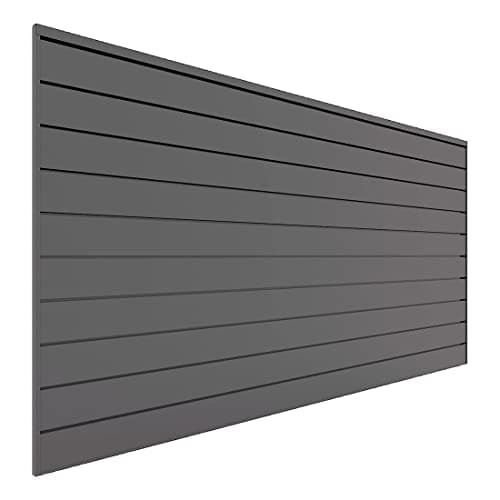 Buy this if anything has weight Proslat PVC Slatwall Panels 75 lb per sq ft published, with the fastener and stud spacing stated. | A full wall done once, on a normal stud-framed garage | 75 lb / sq ftInstall doc | |
| 2 | 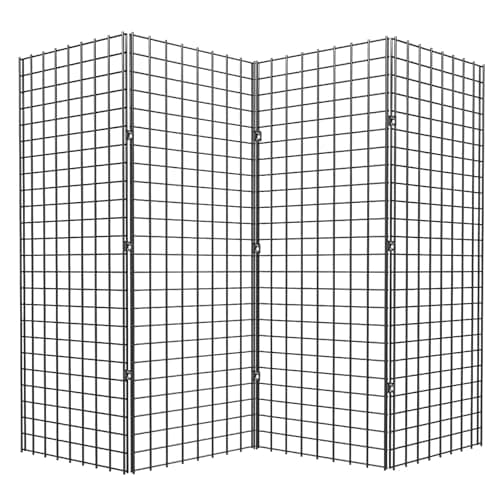 Best gridwall, complete Yeson 2' x 6' Gridwall Panels, 4-Pack Four 2 x 6 ft panels, 20 hooks, 3 in. grid published - no rating anywhere. | Covering a wall in grid cheaply, with the hooks already in the box | Not published | |
| 3 |  Cheapest way to try gridwall Koretech Grid Wall Panels, 3-Pack Three panels, PVC over steel, reconfigurable. No hooks, no rating. | Trying gridwall on one wall before committing to it | Not published | |
| 4 | 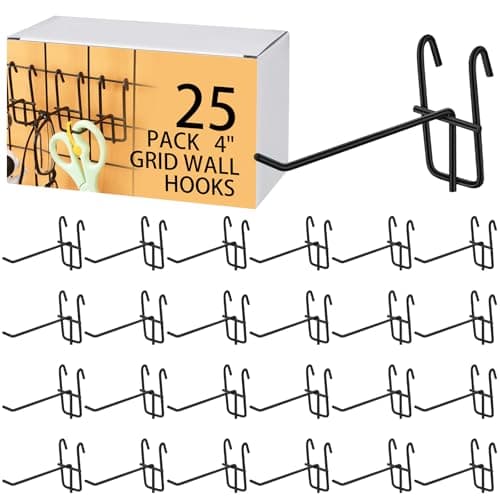 The hooks, and the 4 inch limit Moxweyeni 4″ Gridwall Hooks, 25-Pack 25 hooks at 4 in. and 3.3 mm published. What they hold is not. | Filling a grid wall with hooks for the price of one slatwall hook set | Not published |
#ad We earn a commission if you buy through this link, at no extra cost to you. How this site is funded. Prices last checked October 15, 2026.
Gridwall is the wire grid you have seen in every market stall and craft fair: 2 by 6 foot steel panels on a square grid, hooks that clip on anywhere, cheap by the panel. It turns up in garage searches because it is a fraction of the price of a slatwall wall and because the hooks go where you want rather than where a slot allows. Both of those advantages are real. There is one specific reason it is still the wrong choice for most of what a garage holds.
The asymmetry: geometry versus capacity
Put the two product classes side by side and they publish almost exactly opposite things.
Gridwall figures read from the live listings on 15 October 2026; slatwall figures are the manufacturers' own, documented in full on the capacity reference. 'Not published' is the finding, not a gap in the research.
| System | Published capacity | Published geometry | Fixing spec | Hooks included |
|---|---|---|---|---|
| Proslat PVC slatwall | 75 lb / sq ft | Not published — no slot pitch | 1-1/2″ #8, studs at 16″ | No |
| storeWALL Heavy Duty | 300 lb / sq ft | Not published — no slot pitch | HD InstallStrips | No |
| Yeson gridwall, 4-pack | Not published | 3″ x 3″ grid | Not published — wall or freestanding, unspecified | 20 hooks |
| Koretech gridwall, 3-pack | Not published | 24 x 71″ panels | Not published | No |
| Moxweyeni gridwall hooks | Not published | 4″ long, 3.3 mm | Clips on, no tools | 25 per pack |
Read the first two columns together and the trade is stark. Slatwall tells you what a square foot of wall holds and declines to tell you the slot pitch. Gridwall tells you the grid is 3 inches square and the hook is 4 inches long in 3.3 millimeter wire, and tells you nothing whatsoever about weight. Neither class is being generous; they are each withholding the other’s strong point.
The difference is that only one of those omissions can hurt you. A missing slot pitch costs you an afternoon of checking accessory compatibility, which is annoying and recoverable. A missing weight rating on the thing holding a loaded toolbox over a car hood is the number you actually needed.
Where gridwall genuinely wins
Hook placement in two dimensions. This is the real advantage and it is not small. A slatwall hook can go anywhere along a slot but only on the slots, which on a typical panel means a horizontal line every few inches. A gridwall hook goes anywhere on a 3 inch lattice, including directly above another hook. For hanging a lot of small differently-shaped things in a dense arrangement — which is most of what ends up on a garage wall — that freedom is worth having.
Price per square foot of wall. Gridwall is markedly cheaper than any slatwall on this site, and the cheaper of the two panel packs here costs a fraction of a single 4 by 8 slatwall section while covering a comparable area. If the wall is a utility corner rather than the main event, that gap is hard to argue with.
It comes apart. Both panel packs here state they can be wall-mounted or joined into a freestanding display, and the hooks clip on without tools. A renter, or anyone who expects to reorganize the garage twice more before settling, can take a grid wall down in minutes and put it up somewhere else. Slatwall is screwed into studs and finished with trim; it is a fixture.
Where it loses, and why that decides it
Nobody publishes a rating, including for the hooks. The hook is the part that fails first in any wall system — the point already documented in slatwall accessories and compatibility, where only two of six accessory sets publish a figure. In gridwall, zero of the products we examined publish one, panels included. You are left reasoning from wire thickness, and 3.3 millimeters of stainless is a genuinely useful thing to know, but it is not a rating and this page is not going to present it as one.
No fixing specification. Slatwall brands publish the fastener and the stud spacing their rating assumes — Proslat names 1-1/2 inch #8 pan heads into studs at 16 inch centers. Gridwall listings say the panel “can be mounted on the wall” and stop. So even if a panel had a rating, you would not know what mounting that rating assumes, which on a wire panel screwed through four corners into whatever is behind it is the whole question.
Open wire has no face. A grid is holes. Nothing rests on it, small parts drop through it, and a shelf bracket on a grid is bearing on two wires rather than a continuous slot. Slatwall gives you a flat panel face, which is why shelves and bins work on it and why it takes a cabinet-style accessory at all.
Tool-free is reversible. The hooks clip on without tools, which is the feature; it also means they lift off without tools. In a garage where the door slams and things get knocked, a hook that unseats is a hook that drops what it is holding.
The picks
Proslat PVC Slatwall Panels
Proslat · PVC Slatwall
#ad We earn a commission if you buy through this link, at no extra cost to you. How this site is funded. Prices last checked October 15, 2026.
The default PVC slatwall, and the one whose documentation actually tells you how to hit the rating: 1-1/2 inch #8 pan head screws into studs at 16 inch spacing. The 75 lb per square foot figure is published without a load distance, so treat it as a flat-against-the-wall number.
- Load distance:
- not stated by the manufacturer, so treat the figure as a flat-against-the-wall number
- Fastening:
- 1-1/2" #8 pan head screws, studs at 16" spacing
Proslat states the fastener and the stud spacing, which most of this category does not. It does not state a load distance.
- Published rating
- 75 lb / sq ftInstall doc
- Dimensions
- 8 ft x 4 ft sections, 10 single slats per boxManufacturer
- Steel gauge
- Not published — this manufacturer does not state one
- Thickness
- Not published
- Material
- High-density PVCManufacturer
- Coverage
- Not published
- Warranty
- Not published
- Publishes the fastener spec and stud spacing its rating assumes
- Hidden-screw design, so the finished wall has no visible fixings
- PVC does not care about garage humidity the way MDF slatwall does
- 75 lb/sq ft is the lowest published rating of the PVC systems here
- No load distance published, so bracket-mounted shelving is unquantified
The reason it leads a page about gridwall is the column gridwall leaves blank: 75 lb per square foot, published, with the fastener named and the stud spacing stated at 16 inch centers. That is not the highest figure in slatwall — storeWALL publishes 300 — but it is published, checkable, and tied to a stated mounting, which is more than the entire gridwall category manages.
It costs several times a gridwall panel pack for the same wall, it publishes no slot pitch so accessory compatibility needs checking, and no load distance is given with the 75 lb, so bracket-hung shelving stays unquantified. Stock on this SKU also runs to a lead time rather than shipping immediately.
Yeson 2' x 6' Gridwall Panels, 4-Pack
Yeson · 2' x 6' Gridwall Panel, 4-Pack with 9 Connectors and 20 Hooks
#ad We earn a commission if you buy through this link, at no extra cost to you. How this site is funded. Prices last checked October 15, 2026.
The complete gridwall answer: four 2 by 6 foot panels, nine connectors and twenty hooks in one box, on a published 3 inch square grid. It is the only panel here that states the grid pitch, and like every gridwall product it states no weight rating at all.
- Published rating
- Not published — no load figure from this manufacturer
- Dimensions
- 2 ft x 6 ft panels, 4 per box; 3 in. x 3 in. gridRetailer listing
- Steel gauge
- Not published — this manufacturer does not state one
- Thickness
- Not published
- Material
- Reinforced steel, black finishRetailer listing
- Coverage
- Not published
- Warranty
- Not published
- Publishes the grid pitch - 3 in. x 3 in. - which decides accessory fit
- Nine connectors and twenty hooks included, so the wall works out of the box
- Hooks can go anywhere on the grid, not just on a horizontal line
- Wall-mounted or freestanding, per the listing, so it can move with you
- No weight rating published for the panel - the central gap in this class
- No wire gauge or tube diameter published either
- No fixing or stud spacing specified for the wall-mounted option
- Open wire, so small parts fall through and nothing can rest on a flat face
If gridwall is the right answer for your wall, this is the version to buy: four 2 by 6 foot panels, nine connectors and twenty hooks in one box, so the wall is usable the day it arrives. It is also the only panel here that publishes the 3 inch square grid, which is the figure that decides whether any given basket or shelf will fit — and the one piece of geometry slatwall brands almost never give you.
No weight rating, no wire gauge, no tube diameter, and no fixing spec for the wall-mounted option, so what it holds and how you should hang it are both left to you. Open wire means small parts fall through and nothing rests on a flat face. Buy it for a dense array of light tools, not for the heavy end of the garage.
Koretech Grid Wall Panels, 3-Pack
Koretech · Grid Wall Panel, 3-Piece Commercial Grade
#ad We earn a commission if you buy through this link, at no extra cost to you. How this site is funded. Prices last checked October 15, 2026.
The cheapest way into gridwall: three 24 by 71 inch panels that can be hung as a 6 by 6 foot block or split up, in PVC-coated steel. No hooks are included and, in common with every gridwall listing we can find, no weight rating is published.
- Published rating
- Not published — no load figure from this manufacturer
- Dimensions
- 24" W x 71" H per panel, 3 per box; combines to 71" x 71"Retailer listing
- Steel gauge
- Not published — this manufacturer does not state one
- Thickness
- Not published
- Material
- Steel with a thick PVC coatingRetailer listing
- Coverage
- Not published
- Warranty
- Not published
- Cheapest entry to a grid wall of any product on this page
- Three panels reconfigure as 2 x 6 ft or 2 x 3 ft, so odd walls work
- PVC coating over steel, which is the right direction for a damp garage
- 17.1 lb for three panels, so one person can hang them
- No weight rating published, like every gridwall product here
- No grid pitch published, so accessory fit has to be measured on arrival
- No hooks included - budget for them separately
- No wire gauge or coating thickness published
The lowest-cost route onto a grid wall of anything on this page: three 24 by 71 inch panels in PVC-coated steel that combine into a 71 inch square block or split into smaller runs, so an awkward wall is workable. PVC over steel is the right direction for a damp garage, and at 17.1 lb for all three one person can hang them.
It publishes no weight rating and, unlike the Yeson, no grid pitch either — so accessory fit has to be measured when the panels arrive rather than checked before ordering. No hooks are included, so the real cost is this plus a hook pack. No wire gauge or coating thickness is published.
Moxweyeni 4″ Gridwall Hooks, 25-Pack
Moxweyeni · 4" Grid Wall Double Hook, 25-Pack
#ad We earn a commission if you buy through this link, at no extra cost to you. How this site is funded. Prices last checked October 15, 2026.
Twenty-five hooks that clip onto a grid with no tools, and the only accessory on this page that publishes its own dimensions: 4 inches long in 3.3 mm stainless. What it does not publish is what any one of them holds, which on the part that carries the load is the omission that matters.
- Published rating
- Not published — no load figure from this manufacturer
- Dimensions
- 4" (100 mm) long, 3.3 mm thick; 25 hooks per packRetailer listing
- Steel gauge
- Not published — this manufacturer does not state one
- Thickness
- Not published
- Material
- Stainless steel, electroplatedRetailer listing
- Coverage
- Not published
- Warranty
- Not published
- Publishes its own length and wire thickness, 4 in. and 3.3 mm
- Twenty-five hooks a pack, enough to populate a whole grid wall at once
- Clip on with no tools and lift off again, so a layout can be rearranged
- Stainless and electroplated, which suits an unheated garage
- No weight rating published, on the component that carries the entire load
- Four inches is short - deep or bulky items will not sit on it
- Tool-free mounting means they lift off as easily as they clip on
- Only fits grid panels; useless on slatwall or pegboard
Twenty-five hooks for about what a single slatwall hook set costs, and the only accessory on this page that publishes its own dimensions: 4 inches long in 3.3 millimeter electroplated stainless. That wire thickness is the most useful number in the whole gridwall category, because it is at least a physical property you can compare.
It is not a weight rating, and none is published — on the component that carries the entire load. Four inches is also short: deep or bulky items will not sit on it, which quietly limits a grid wall to flat and small. And tool-free mounting cuts both ways, since a hook that clips on without tools lifts off the same way.
The accessories are where the real cost lands
Panels are the cheap half of either wall. What you hang on them is the expensive half, and the two systems diverge sharply here in a way the panel price hides.
Gridwall accessories are a commodity. Because gridwall is a decades-old retail standard on a common 3 inch grid, hooks, baskets and small shelves are made by dozens of unrelated suppliers and priced accordingly — the 25-hook pack below costs about what a single slatwall hook set does. If you intend to cover a wall densely with hooks, that difference compounds and can easily exceed the panel saving.
Slatwall accessories are proprietary, or near enough. Slot profiles differ between manufacturers, so a hook bought for one brand may sit loose in another, and the first-party ranges are priced as system components rather than commodities. The upside is that the better ones publish a rating at all, which no gridwall accessory we examined does. You are paying for a number and for a system that is designed as a system.
The practical consequence is that comparing the two on panel price alone flatters gridwall twice over: once because the panels really are cheaper, and once because the hooks are too. Add up the whole wall — panels plus however many hooks, baskets and shelves it will actually carry — before deciding, and check what each accessory publishes while you are there. On a grid wall the honest answer is usually that nothing does.
Which to buy, stated plainly
Buy gridwall if what is going on the wall is light, numerous, and likely to be rearranged: hand tools, cables, spray cans, gardening bits, craft and hobby kit. Buy it if the wall is temporary or rented. Buy it if the budget for the whole wall is less than one slatwall section, which is a perfectly honest reason and the one most people actually have.
Buy slatwall the moment anything on the wall has mass, or the moment you want a shelf rather than a hook, or if you want to be able to look up a number before you load it. That is the whole case and it rests on one column of the table above. If you are choosing between slatwall and the other two contenders rather than gridwall, the three-way comparison in slatwall vs pegboard vs French cleat is the better page, and the ranked wall systems roundup puts every published figure in one table.
- Everything going up is light, and there is a lot of it
- You want hooks above hooks, not just along a slot line
- The wall is rented, temporary, or going to be rearranged
- The budget for the whole wall is under the price of one slatwall section
- Anything on the wall has real mass and you want a number for it
- You want shelves and bins, which need a flat panel face
- Small parts would fall through an open grid
- You need a stated fastener and stud spacing for the fixing
One last point that applies to both. Neither system is any stronger than what it is screwed to. Every slatwall rating on this site assumes studs, and no gridwall listing states a fixing at all, so on a block or poured-concrete garage wall the anchor becomes the limiting factor for either choice — which is set out in mounting to drywall versus masonry.
Common questions
Is gridwall strong enough for a garage?
What is the difference between slatwall and gridwall?
Can gridwall hooks be used on slatwall?
How much wall does a gridwall panel pack cover?
Is gridwall cheaper than slatwall?
Sources
- Yeson 2' x 6' gridwall 4-pack - 3 in. square grid, 9 connectors, 20 hooks, reinforced steel
- Koretech gridwall 3-pack - 24 x 71 in panels, PVC-coated steel, 17.1 lb for three
- Moxweyeni gridwall hooks 25-pack - 4 in (100 mm) long, 3.3 mm stainless, electroplated
- Proslat FAQ - 75 lb per sq ft, 1-1/2 in #8 pan head screws, 16 in stud spacing
- storeWALL Heavy Duty - 300 lb per sq ft at the surface, 165 lb at 4 in out
Figures were read on the dates shown against each source. If one has changed, or if we have got something wrong, tell us and we will correct the page.
Read next
- SlatwallSlatwall vs pegboard vs French cleatCost, capacity, install time, accessory lock-in and moisture behavior across all three systems in one table.
- SlatwallHow much weight can slatwall actually hold?The full cross-brand load table, normalized into one unit, with what each rating assumes stated beside it.
- SlatwallThe best garage wall systemsNine wall systems ranked on normalized load rating and on how honestly each manufacturer documents it.
- SlatwallSlatwall accessories and compatibilityCross-brand compatibility, why pegboard hooks do not fit, and the per-hook limits that decide real capacity.
- SlatwallBest pegboard for a garageMetal, polypropylene and hardboard pegboard ranked on the published figure, including the one that publishes none.