How many slatwall panels do you need
Sold by the section, the case or the pack - and almost never by the square foot you are actually trying to cover.
#ad We earn a commission if you buy through this link, at no extra cost to you. How this site is funded. Prices last checked October 11, 2026.
Quick picks
Ranked by how much wall one purchase actually covers, smallest useful unit first, because the commonest mistake in this category is buying for the garage you imagine rather than the wall you measured.
| # | Product | Best for | Published rating | Buy |
|---|---|---|---|---|
| 1 | 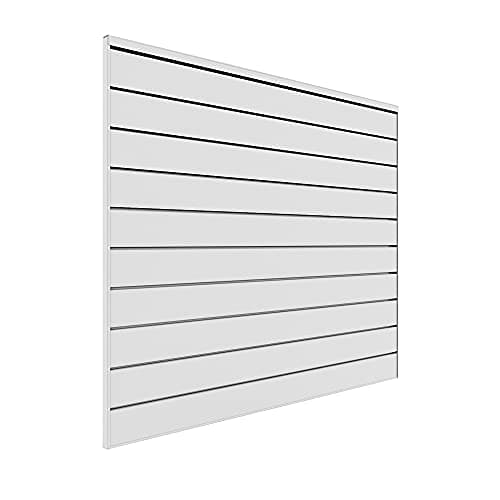 Smallest useful unit Proslat PVC Slatwall, 4′ x 4′ Section A 4 x 4 ft section, about 16 sq ft - one bay, without over-buying. | One bay of wall, without paying for panels you will not hang | 75 lb / sq ftInstall doc | |
| 2 | 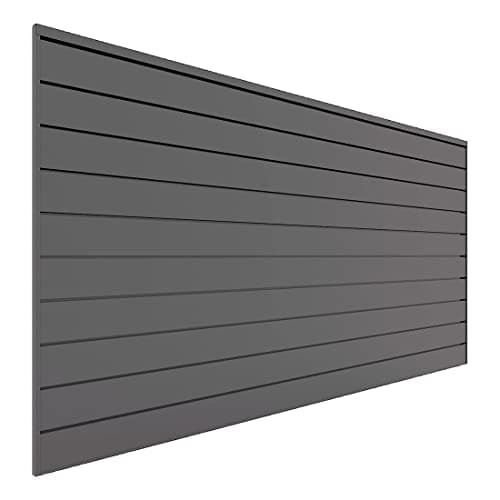 The standard section Proslat PVC Slatwall Panels A 4 x 8 ft section, about 32 sq ft. The unit most of this category is sold in. | A full wall done once, on a normal stud-framed garage | 75 lb / sq ftInstall doc | |
| 3 | 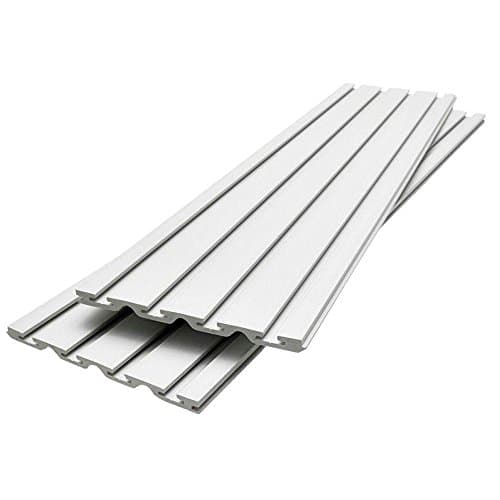 Cheapest entry, smallest coverage Gladiator 4' GearWall Panels (2-Pack) Two 48 x 12 in panels - roughly 8 sq ft, so a wall takes several packs. | Buyers already committed to Gladiator hooks and baskets | 50 lb / sq ftManufacturer |
#ad We earn a commission if you buy through this link, at no extra cost to you. How this site is funded. Prices last checked October 11, 2026.
This is the question that decides what you spend, and it is the one the category is worst at answering. Search for slatwall and you get a wall of results priced per box with no statement of how much wall a box covers. Search for “slatwall panels 4x8” and you find that 4 by 8 is the standard unit — but what arrives is not one 4 by 8 sheet. It is ten narrow slats that you stack to make a 4 by 8 band of wall.
What actually arrives in the box
Proslat’s own FAQ is unusually specific and worth quoting, because it explains the format for most of the category: “Each box of 4x8 ft Slatwall comes with 10 individual slat panels, 1 x 95.75″ bottom trim, 2 x 48.75″ side trims, and 1 x 95.75″ top trim.” So the slats are about 96 inches long, ten of them stack to about 48 inches tall, and the finished band is 8 ft wide by 4 ft high. Eight times four is 32 square feet.
That number is arithmetic, not a quotation. Proslat publishes the box contents and the panel lengths; it does not publish a square-foot coverage figure anywhere we could find. Neither does Gladiator, which publishes a panel size of 48 x 12 x 0.75 inches and a 2-pack, and leaves you to multiply. This is why the coverage column below carries a provenance marker on every row: on this page, a derived figure is never dressed up as a published one.
The trims are part of the quantity, and nobody counts them
Read the Proslat box contents again and notice what else is in there: one 95.75″ bottom trim, two 48.75″ side trims, one 95.75″ top trim. Those lengths are not arbitrary — they are exactly one box’s worth of edge. The two long trims finish the top and bottom of an 8 foot run, and the two short ones finish the left and right edges of a 4 foot tall band.
Which means a single box trims itself perfectly and two boxes side by side do not. Put two 8 foot sections end to end and you have a 16 foot run with four long trims, which is correct, and four side trims, which is two more than the finished wall needs. Stack two sections to make an 8 foot tall band instead and the arithmetic inverts: you need the side trims and have surplus top and bottom.
Nobody publishes a trim calculation, so the practical rule is to sketch the outline of the finished panel area before ordering and count its four edges in feet. Long runs are trim-rich and trim-poor at the same time in a way that only shows up when you are standing in the garage holding the last offcut. The surplus is cheap and the shortfall means another order, so if the run is an awkward length, err toward the extra box rather than toward exactly enough.
One more thing about edges that is easy to get wrong before you measure: a slatwall band does not have to start at a stud and it does not have to end at one, but every panel does have to be screwed into one. Proslat states 16 inch stud spacing for its rating, so a run that ends 6 inches past the last stud leaves a strip with nothing behind it. Either stop the band at the last stud or cut the final slat to land on it — cutting slatwall panels covers how, and it is a saw cut rather than a problem.
Unit sizes and panel counts are each maker's published figures, read 11 October 2026. 'Computed' means the maker publishes panel dimensions but no coverage figure, and the area is ours.
| System | Unit as sold | Coverage | Source of coverage | Published rating |
|---|---|---|---|---|
| Proslat PVC, 4 x 8 section | Box of 10 slats + trims | ~32 sq ft | Our arithmetic | 75 lb / sq ft |
| Proslat PVC, 4 x 4 section | Box of 10 slats | ~16 sq ft | Our arithmetic | 75 lb / sq ft |
| storeWALL Heavy Duty | Case of four 8 ft panels | 40 sq ft | Manufacturer | 80 lb / sq ft |
| storeWALL Heavy Duty, 4 ft set | Set of four 4 ft panels | 20 sq ft | Retailer listing | 80 lb / sq ft |
| Flow Wall panel pack | Six 4 ft panels | 24 sq ft | Manufacturer | Not published — per sq ft |
| Gladiator GearWall, 2-pack | Two 48 x 12 in panels | ~8 sq ft | Our arithmetic | 50 lb / sq ft |
Three things fall out of that table. The first is that storeWALL and Flow Wall are the only systems here that tell you the coverage — 40 sq ft a case and 24 sq ft a pack respectively, both stated by the maker. Everyone else makes you derive it. The second is that the spread in unit size is enormous: one storeWALL case covers five times what one Gladiator 2-pack does, which makes per-box prices across brands meaningless until you convert them to the same unit of wall.
The third is the one that costs people money. Look at the two storeWALL rows: both are “four panels”, and one covers twice the wall of the other, because one set is 8 foot panels and the other is 4 foot panels. A pack count is not a quantity. The only numbers that mean anything here are the panel length and how many you get.
The arithmetic for your wall
Three measurements and one decision, in this order.
- 01
Measure the width you will actually panel
Wall to wall, minus anything you are not covering: the door swing, the window, the service panel, the run behind where the car mirror sits. This is the number people get wrong by guessing at the whole wall. - 02
Decide the height band, not the wall height
Almost nobody panels floor to ceiling, and nobody should. A 4 ft band with its bottom edge somewhere around 36 to 40 inches off the floor puts every hook inside normal reach and leaves the floor free. Four feet is also exactly what one section height gives you, which is not a coincidence. - 03
Multiply, then divide by the section area
Width in feet times band height in feet gives your square footage. Divide by 32 for 4 x 8 sections, 16 for 4 x 4, 40 for a storeWALL case. Round up, never down. - 04
Add one section if the wall is not a clean multiple
Offcuts are not waste in this category - a cut slat still hangs accessories, and you will want spare for the awkward strip beside a door. Buying exactly to the number is how people end up 14 inches short.
Now put a service door in the middle of that same wall and the answer changes shape rather than size. Twelve feet of wall with a 32 inch door in it leaves two paneled strips of roughly 4 ft 8 in each, not one run of 9 ft 4 in — and each strip needs its own side trims and its own cut to land on a stud. The square footage barely moves, the trim count goes up, and the number of cuts doubles. This is the case where the smaller section earns its price premium, because two short runs waste less of a 4 foot box than they do of an 8 foot one.
32sq ft
What one 4 x 8 ft slatwall section covers - ten slats stacked into a 4 ft band, derived from Proslat's published box contents
The picks, by how much wall one purchase covers
Proslat PVC Slatwall, 4′ x 4′ Section
Proslat · 88103 PVC Slatwall, 4 ft x 4 ft Section
#ad We earn a commission if you buy through this link, at no extra cost to you. How this site is funded. Prices last checked October 11, 2026.
The same PVC slatwall and the same published 75 lb per square foot as the 8 foot section, in the smallest pack Proslat sells. This is the one to buy when the wall you actually mean to cover is a single bay between a door and a corner, rather than a whole garage side.
- Load distance:
- not stated by the manufacturer, so treat the figure as a flat-against-the-wall number
- Fastening:
- 1-1/2" #8 pan head screws, studs at 16" spacing
Proslat publishes 'PVC Slatwall can hold up to 75 lbs. per sq.ft.' for the PVC line, with the fastener and 16 in. stud spacing stated. No load distance is given, and the FAQ does not break the rating out by SKU, so the figure is the line's rather than this pack's.
- Published rating
- 75 lb / sq ftInstall doc
- Dimensions
- 4 ft x 4 ft section, 10 single slats per boxRetailer listing
- Steel gauge
- Not published — this manufacturer does not state one
- Thickness
- Not published
- Material
- High-density PVCManufacturer
- Coverage
- Not published
- Warranty
- Not published
- Half the wall of the 8 ft box, so a one-bay job does not over-buy
- Same published rating, fastener spec and material as the larger section
- Ten slats stack to a 4 ft band, which is the usable hanging height anyway
- PVC, so garage humidity is not a consideration
- Costs more per square foot of wall than the 8 ft section
- Proslat's FAQ does not document this pack, so its size comes from the listing
- No coverage figure published by anyone - it has to be derived
- No load distance published, so bracket-hung shelving stays unquantified
Ten slats that stack into a 4 by 4 foot band — about 16 square feet — at the same published 75 lb per square foot as the longer section, with the same fastener spec and the same PVC. If the wall you actually measured is one bay between a door and a corner, this is the box that does not leave you with panels in the rafters.
Two honest limits. It costs more per square foot of wall than the 8 foot section, so it is the right buy for a small wall and the wrong one for a cheap wall. And Proslat’s own FAQ documents only the 4 x 8 box, so the section size here comes from the retail listing rather than the manufacturer — a thinner source than we would like for the one figure the page is about.
Proslat PVC Slatwall Panels
Proslat · PVC Slatwall
#ad We earn a commission if you buy through this link, at no extra cost to you. How this site is funded. Prices last checked October 11, 2026.
The default PVC slatwall, and the one whose documentation actually tells you how to hit the rating: 1-1/2 inch #8 pan head screws into studs at 16 inch spacing. The 75 lb per square foot figure is published without a load distance, so treat it as a flat-against-the-wall number.
- Load distance:
- not stated by the manufacturer, so treat the figure as a flat-against-the-wall number
- Fastening:
- 1-1/2" #8 pan head screws, studs at 16" spacing
Proslat states the fastener and the stud spacing, which most of this category does not. It does not state a load distance.
- Published rating
- 75 lb / sq ftInstall doc
- Dimensions
- 8 ft x 4 ft sections, 10 single slats per boxManufacturer
- Steel gauge
- Not published — this manufacturer does not state one
- Thickness
- Not published
- Material
- High-density PVCManufacturer
- Coverage
- Not published
- Warranty
- Not published
- Publishes the fastener spec and stud spacing its rating assumes
- Hidden-screw design, so the finished wall has no visible fixings
- PVC does not care about garage humidity the way MDF slatwall does
- 75 lb/sq ft is the lowest published rating of the PVC systems here
- No load distance published, so bracket-mounted shelving is unquantified
The unit the category is built around, and the best documented: box contents published slat by slat, the fastener named (1-1/2″ #8 pan head) and the stud spacing stated at 16 inches. Ten slats, a 4 by 8 foot band, about 32 square feet, and the cheapest route to a full wall per square foot of anything priced on this page.
Its 75 lb per square foot is the lowest published figure of the PVC systems we compare, and no load distance is given with it, so bracket-hung shelving sticking out from the wall stays unquantified. Worth knowing before you plan a shelf run rather than hooks. Stock on this SKU also runs to a lead time rather than shipping immediately, so check the date before you book the Saturday.
Gladiator 4' GearWall Panels (2-Pack)
Gladiator · GearWall Panels
#ad We earn a commission if you buy through this link, at no extra cost to you. How this site is funded. Prices last checked October 11, 2026.
The lowest published panel rating in this comparison at 50 lb per square foot, which is easy to miss because Gladiator rates its own GearTrack rail in a completely different unit on an adjacent page. Buy it for the accessory ecosystem, not for the load number.
- Load distance:
- not stated by the manufacturer, so treat the figure as a flat-against-the-wall number
- Fastening:
- not stated by the manufacturer
Published as 'Holds 50 lbs per square ft.' Re-checked 2026-10-11: the figure is unchanged on Gladiator's page, and the 2-pack (GAWP042P) is listed and priced on Amazon again after being unavailable through early October. Gladiator publishes the panel dimensions but no square-foot coverage for the pack.
- Published rating
- 50 lb / sq ftManufacturer
- Dimensions
- 48" W x 12" H x 0.75" DManufacturer
- Steel gauge
- Not published — this manufacturer does not state one
- Thickness
- Not published
- Material
- Not published
- Coverage
- Not published
- Warranty
- Not published
- Largest first-party accessory range of any system here
- Color-matched screws included
- Rated by Gladiator to handle heat, cold and humidity extremes
- 50 lb/sq ft is the lowest published panel rating in this comparison
- Neither a load distance nor a stud spacing is published
- A 2-pack covers only about 8 sq ft, so a single-bay wall takes several packs
The lowest price of anything here and, not coincidentally, the least wall: two panels at 48 by 12 inches each, which works out at roughly 8 square feet a pack. Buy it because you are already in the Gladiator accessory ecosystem and want the hooks and baskets to fit, which is a genuinely good reason.
Do not buy it as a cheap way to panel a wall, because it is not one: covering the 48 square foot example above takes six packs. Gladiator also publishes the lowest panel rating in this comparison at 50 lb per square foot, with neither a load distance nor a stud spacing beside it, and no coverage figure for the pack at all. It was unavailable on Amazon through early October and is listed again as we write.
storeWALL publishes the number, and still proves the point
storeWALL is not in the picks above because we cannot deep-link it, but it belongs on this page because it is the one maker that publishes the figure the page is about — and because it demonstrates the trap better than anyone. Its own site states a case of four 8 foot panels at 40 square feet, with the highest published rating in this comparison at 80 lb per square foot. On Amazon, meanwhile, the listing we can find for the same Heavy Duty panels is a “Set of 4 Panels, Covers 20 sq. ft.” — four panels again, half the wall, because these are the 4 foot panels rather than the 8 foot ones.
Same brand, same product line, same “set of four panels”, and a twofold difference in the wall you end up with. If you take one thing from this page, take that: count the panels and their length, never the pack. A pack count tells you nothing at all.
What nobody publishes, and what to do about it
Three gaps are worth naming, because they are the same three on every brand’s page. No maker here publishes a coverage figure for a single panel, only for a pack or not at all. No maker publishes how much wall the trims finish, so a job that needs trim on four edges needs a trim count you have to work out from the strip lengths. And with the exception of storeWALL, nobody states the distance from the wall at which their per-square-foot rating holds — so the rating describes a flat load against the panel, not a shelf bracket cantilevered off it.
The practical consequence is that the coverage arithmetic above is the most reliable number in this purchase, and it is yours rather than theirs. If you want the capacity side of the same problem, the slatwall weight capacity reference sets out what each rating assumes, and panel materials covers why a PVC panel and an MDF one behave differently in a garage even at the same published figure.
- The wall is a clean multiple of 4 or 8 feet and the band is 4 feet
- You are paneling one bay and want the smallest box that covers it
- You want offcuts on purpose, for the awkward strip beside a door
- The system is one whose maker publishes a coverage figure you can check
- You are comparing per-box prices across brands, where the unit sizes differ fivefold
- The wall has a door swing, window or service panel inside the run
- You intend to hang bracket shelving, where the per-sq-ft rating is not the governing number
- You are buying a pack whose coverage you had to derive rather than read
One last thing worth saying plainly: buy the panels and the accessories as one decision. The accessory range is part of what you are choosing, and a cheap panel with nothing that fits it is a false economy — which is the argument set out in slatwall accessories and compatibility. Panels are the cheap half of a slatwall wall. The hooks are where the money actually goes.
Common questions
Do slatwall panels come in 4x8 sheets?
How many slatwall panels do I need for a two-car garage wall?
How high should the slatwall band be?
Which slatwall brands publish how much wall a pack covers?
Is it cheaper to buy the biggest pack?
Sources
- Proslat FAQ - 4x8 ft box contents (10 slats plus trims), 75 lb per sq ft, fastener and 16 in stud spacing
- Proslat 88103 retail listing - 4 ft x 4 ft section, 10 panels
- storeWALL Heavy Duty - case of four 8 ft panels published at 40 sq ft, 80 lb per sq ft
- storeWALL Heavy Duty 4 ft panels retail listing - set of four panels published as covering 20 sq ft
- Flow Wall 24 sq ft panel pack - six 4 ft panels
- Gladiator 4' GearWall Panels (2-pack) - 48 x 12 x 0.75 in per panel, 50 lb per sq ft
Figures were read on the dates shown against each source. If one has changed, or if we have got something wrong, tell us and we will correct the page.
Read next
- SlatwallThe best garage wall systemsNine wall systems ranked on normalized load rating and on how honestly each manufacturer documents it.
- SlatwallSlatwall panel materials comparedWhat each panel material does in a garage, with published thicknesses and warranties where manufacturers state them.
- SlatwallHow to install slatwall in a garageThe install sequence for all three garage substrates, with the fastener specification each manufacturer publishes.
- SlatwallHow to cut slatwall panelsBlade tooth counts by panel material, and the technique that stops PVC chipping along the slot edges.
- SlatwallHow much weight can slatwall actually hold?The full cross-brand load table, normalized into one unit, with what each rating assumes stated beside it.