Slatwall panel materials compared
Solid-core PVC, cellular PVC, MDF and aluminum — and why the warranty length tells you more than the material name.
#ad We earn a commission if you buy through this link, at no extra cost to you. How this site is funded. Prices last checked October 17, 2026.
Quick picks
Ranked on published load rating normalized into a common unit, then on how much the manufacturer tells you about what that rating assumes. Tap any row for the full write-up.
| # | Product | Best for | Published rating | Buy |
|---|---|---|---|---|
| 1 | No photo Best material spec storeWALL Heavy Duty Slatwall Panels Solid-core molded PVC at 0.70 inch — the only published thickness we found. | Anyone hanging shelves and brackets, not just hooks | 300 lb / sq ft165 lb at 4″ outManufacturer | |
| 2 | 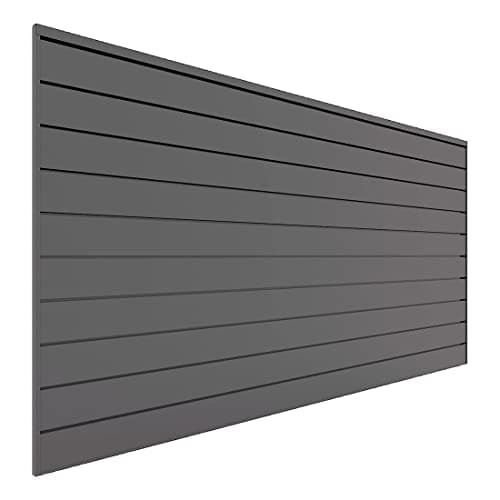 Best value PVC Proslat PVC Slatwall Panels High-density PVC with a lifetime panel warranty. | A full wall done once, on a normal stud-framed garage | 75 lb / sq ftInstall doc | |
| 3 | No photo Cellular PVC option Flow Wall Wall Panel Pack 0.75 inch cellular PVC, masonry-rated, but a one-year warranty. | Garages with a block or poured-concrete wall to cover | 100 lb / sq ftManufacturer |
#ad We earn a commission if you buy through this link, at no extra cost to you. How this site is funded. Prices last checked October 17, 2026.
“PVC” on a garage slatwall product page is doing a lot of work. It covers solid-core molded panels rated at 300 lb per square foot and cellular extrusions rated at 100, which are not the same product in any meaningful sense. Here is what the material names actually mean and what the manufacturers publish about them. Once the material is settled, how many panels you need is the other half of the purchase, and the one the makers document worst.
Only figures the manufacturers publish. Where a cell says Not published, that manufacturer does not state it.
| Material | Published example | Thickness | Warranty | Garage behavior |
|---|---|---|---|---|
| Solid-core molded PVC | storeWALL Heavy Duty | 0.70″ | 10 years | Unaffected by humidity; highest published ratings |
| High-density PVC | Proslat PVC / ProCore | Not published | Lifetime (panels) | Moisture-resistant; ProCore rated 200 lb/sq ft |
| Cellular PVC | Flow Wall | 0.75″ | 1 year | Lighter; masonry substrates named |
| PVC (extruded profile) | Trusscore SlatWall | Not published | 20 years / lifetime registered | Interlocks with Trusscore wall board |
| MDF (retail slatwall) | Generic store-fixture panel | Not published | Not published | Swells with moisture; not for unheated garages |
Solid-core PVC: the top of the range
This is what the highest-rated panels are made of, and storeWALL is the only manufacturer here that publishes a number for it: 0.70 inch, molded solid core. Solid core means the slot profile is cut through continuous material rather than a hollow extrusion, which is why the ratings are what they are — 250 to 300 lb per square foot at the panel face.
Proslat’s ProCore sits in the same class by its rating (200 lb/sq ft), though Proslat does not publish a thickness. The tell is the stud spacing: ProCore is specified at 24 inch centers against 16 for the standard panel, which only makes sense if the panel itself is spanning more.
Cellular PVC: lighter, cheaper, shorter warranty
Flow Wall publishes cellular PVC at 0.75 inch. Cellular means foamed — a lower-density material with gas cells through it, which is why it is lighter and cheaper and why the published rating is 100 rather than 250 lb per square foot.
It is a legitimate material and it does the job for a wall of hooks. The number to weigh it against is the warranty: one year, against ten from storeWALL and twenty from Trusscore. On a product that gets screwed to a wall and left for a decade, that gap is the manufacturer telling you something.
MDF: fine for a shop, wrong for a garage
Most slatwall sold in the world is MDF, because most slatwall goes into retail stores. It is cheap, it takes a laminate or paint finish beautifully, and it is dimensionally stable in a conditioned building.
A garage is not a conditioned building. MDF absorbs moisture, and once it does the slots swell, the faces bulge, and the accessory that used to slide now binds. If the panel edge ever gets wet — a wet floor, a leak, a car brought in covered in snow — the swelling starts at the cut edge and works inward. None of the garage-specific systems in this comparison use it, and that is not an accident.
There is a partial remedy if you have already bought MDF, or inherited it with the building: aluminum groove inserts line the slot so hooks bear on metal rather than on damp fiber, which removes the crumbling failure described above. It does not stop the panel face swelling and nobody publishes what the lined groove then holds, so treat it as damage limitation rather than a fix — what slatwall inserts actually do compares the products and the two other unrelated things sold under the same name.
Aluminum and steel
Aluminum slatwall exists, mostly in commercial and trailer applications. It is expensive, it does not care about anything a garage can do to it, and it needs a non-ferrous blade to cut. For a home garage it is almost always more product than the job requires.
Steel appears in this category mainly as pegboard rather than slatwall — Wall Control’s 20-gauge panels being the reference. Steel’s advantage over any PVC is impact: a dropped socket dents it rather than gouging it, and it does not craze in cold. Its disadvantage is that a deep scratch through powder coat can corrode in a damp garage.
What to actually buy
- The wall will carry shelves and brackets, not just hooks
- You want the published capacity headroom and a 10-year warranty
- The garage is damp, unheated, or both
- You are covering a wall once and not revisiting it
- You are hanging hand tools and garden equipment
- Budget is the binding constraint
- The wall is masonry — Flow Wall names those substrates
- You would rather have steel and published per-hook limits
Common questions
Is PVC or MDF slatwall better for a garage?
How thick is slatwall?
What is the difference between solid-core and cellular PVC slatwall?
Does slatwall warp in a garage?
Sources
- storeWALL Heavy Duty — 0.70 inch molded solid-core PVC, 10-year warranty
- Flow Wall — 0.75 inch cellular PVC, one-year warranty
- Proslat FAQ — high-density PVC, ProCore stud spacing
- Trusscore SlatWall — PVC, 20-year warranty
- Wall Control — 20-gauge steel panels
Figures were read on the dates shown against each source. If one has changed, or if we have got something wrong, tell us and we will correct the page.
Read next
- SlatwallThe best garage wall systemsNine wall systems ranked on normalized load rating and on how honestly each manufacturer documents it.
- SlatwallHow many slatwall panels do you needWhat a section, a case and a pack actually cover, which brands publish a coverage figure, and how to work out your own.
- SlatwallSlatwall inserts explainedAluminum reinforcement, vinyl accent strips and mounting backplates all sell as inserts. What each is for, and the figure none of them states.
- SlatwallHow much weight can slatwall actually hold?The full cross-brand load table, normalized into one unit, with what each rating assumes stated beside it.
- SlatwallHow to cut slatwall panelsBlade tooth counts by panel material, and the technique that stops PVC chipping along the slot edges.