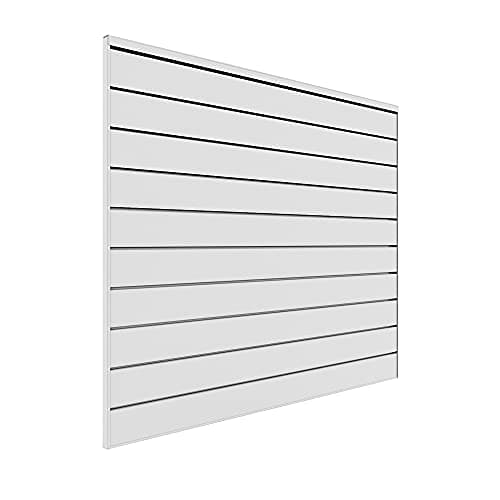
This is the section the site is named after, and it exists because of a single problem: you cannot compare garage wall systems using the numbers the manufacturers print.
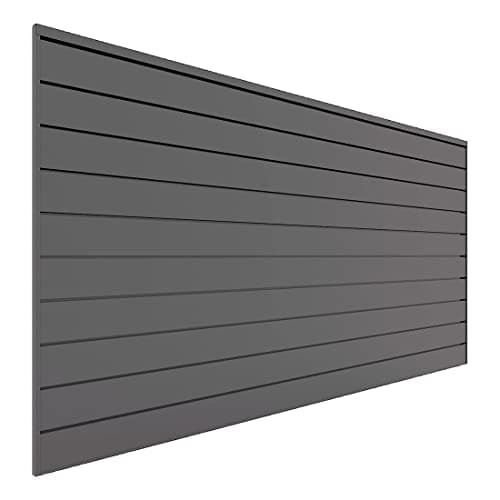
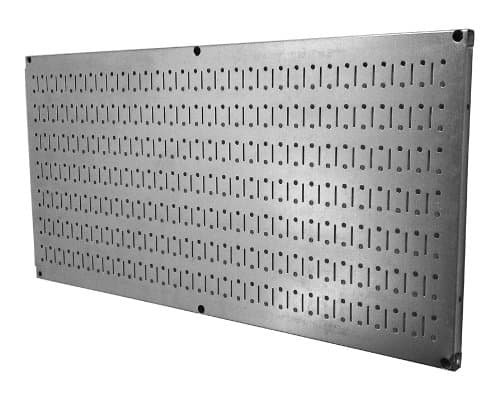
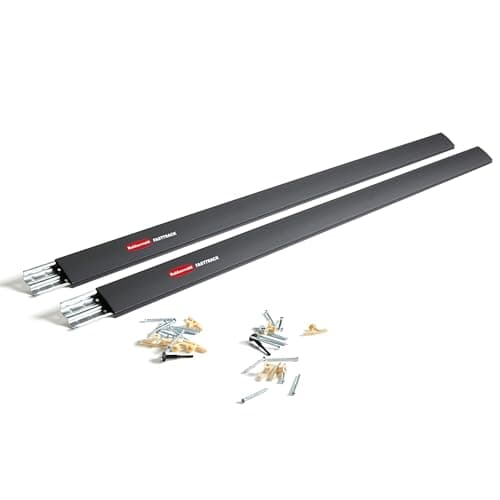
Here is what is actually published, as of September 2026. Proslat rates its PVC slatwall at 75 lb per square foot. storeWALL rates its Heavy Duty panel at 300 lb per square foot. Trusscore rates its SlatWall at 75 lb per square foot. Flow Wall says 100 lb per square foot. Gladiator rates GearWall at 50 lb per square foot — and rates GearTrack, the rail it sells on the adjacent page, at 75 lb per linear foot. Wall Control rates its metal pegboard at 200 lb per panel. That is four different units across products a buyer is choosing between in one afternoon, and nobody converts them for you.
Two things decide whether a rating means anything, and most manufacturers publish neither.
The first is load distance. A bracket holding 50 lb flat against the panel face and a bracket holding 50 lb four inches out are not the same load — the second applies far more leverage to the fastener and the panel slot. storeWALL is the only manufacturer here that publishes both numbers, and the gap is startling: its Heavy Duty panel is rated 300 lb at the panel surface and 165 lb at four inches out. Its Standard Duty panel drops from 250 lb to 115 lb over the same four inches. That is a 45 to 54 percent reduction, published by the manufacturer, on the exact geometry a shelf bracket creates. Every other panel here publishes a single number with no distance attached, which means the honest reading of those figures is "flat against the wall" — and shelves are not flat against the wall.
The second is fastening. Proslat states its fastener and spacing: 1-1/2 inch #8 pan head screws into studs at 16 inch centers. Its higher-rated ProCore panel is specified at 24 inch stud spacing. Wall Control goes furthest of anyone, publishing two capacities for two mounting methods — 100 lb per panel into drywall anchors, 200 lb per panel into studs — plus per-hook and per-shelf limits and a written statement of what the figures assume. Trusscore publishes neither a fastener nor a spacing next to its 75 lb figure.
None of this means the low-rated systems are bad. A 50 lb per square foot panel carrying rakes, extension cords and a leaf blower is nowhere near its limit, and the Gladiator accessory range is the largest in the category by some distance. It means that if you are choosing on capacity, you have to normalize the units first — and if you are hanging anything on a bracket, the number you want is the one at distance, which usually is not the number on the box.
On pegboard and French cleat. Both are legitimate answers and both are cheaper than slatwall. Wall Control's metal pegboard is, on the evidence of its own documentation, the most honestly specified product in this entire category. A French cleat wall built from plywood costs a fraction of any of these systems and can be rebuilt with a circular saw whenever the tools change. Slatwall's advantages are a continuous groove — you can put a hook anywhere along it rather than at fixed hole centers — and a moisture behavior PVC handles better than MDF or bare ply. Those are real advantages. They are not the only way to solve the problem, and any page telling you slatwall always wins is selling slatwall.
One practical note before you buy anything. Almost every rating in this section assumes fastening into studs. If your garage has a block or poured-concrete wall — and a great many do, at least on one side — none of these ratings apply as published, and the fastener becomes the limiting factor rather than the panel. That case has its own guide, because no competitor we looked at covers it at all.
Work out the quantity before you price anything. Slatwall is sold in sections, cases and packs rather than by the square foot, and most makers never publish a coverage figure at all — so two boxes described identically as "four panels" can cover twice as much wall as each other. Measure the width you will actually panel, settle on a 4 ft band rather than floor to ceiling, and convert every product to square feet of wall before you compare prices. The coverage guide below does that conversion for each system.
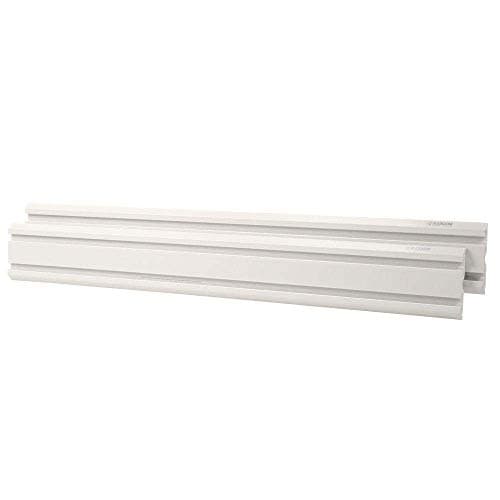
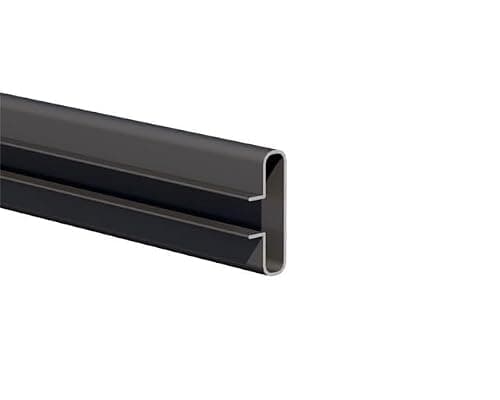
If the panel is MDF, the groove is the weak point. A routed MDF slat has its profile cut into compressed wood fiber, and the lip the hook bears on crushes and crumbles under load rather than snapping — slowly, and faster in a damp garage. Aluminum groove inserts exist to remove that failure mode, and they are worth knowing about before you commit to MDF. Be careful what you buy, though: the word "insert" is also used for purely decorative vinyl strips and for mounting backplates, and not one product in any of the three groups publishes a weight rating.
Gridwall is the cheap alternative, and the one to be careful with. Wire grid panels cost a fraction of slatwall per square foot, and a grid lets a hook sit anywhere rather than only on a slot line, which is a genuine advantage for a dense array of light tools. The catch is the column this whole section is built on: gridwall is a retail-display product, and not one gridwall panel or hook we can find publishes a weight rating at all. It publishes the geometry — a 3 inch grid, a 4 inch hook — and leaves capacity unstated. For light and numerous, it is a reasonable buy; for anything with mass, you want the system that gives you a number.
Below: the roundup, the three-way comparison people actually search for, the flagship capacity reference, the panel coverage arithmetic, the guide to what "insert" actually means, the gridwall head-to-head, and the install guides for drywall, studs and masonry.