Rubbermaid FastTrack
The biggest published number on this site, attached to the smallest one.
#ad We earn a commission if you buy through this link, at no extra cost to you. How this site is funded. Prices last checked October 21, 2026.
Quick picks
The rail against the two wall systems it actually competes with, ranked on published capacity normalized into a comparable unit.
| # | Product | Best for | Published rating | Buy |
|---|---|---|---|---|
| 1 | 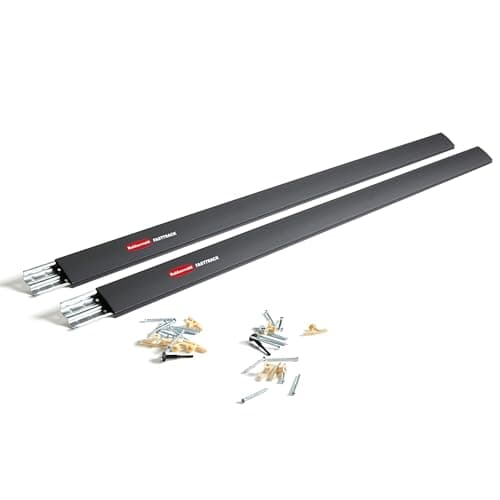 The rail reviewed Rubbermaid FastTrack Garage Rail 1,750 lb per 48 inch rail into studs; hooks rated 25 to 50 lb each. | Hanging long-handled tools and bikes off a rail rather than a panel | 1,750 lb totalInstall doc | |
| 2 | 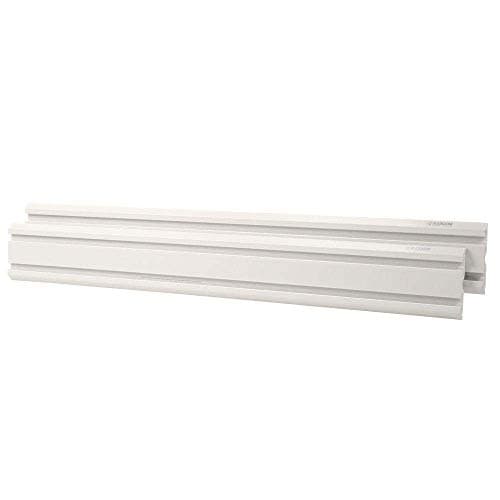 The closest rival Gladiator 4' GearTrack Channels (2-Pack) 75 lb per linear foot, published in a unit you can convert. | Heavy single items — bikes, ladders, wheelbarrows — on a stud wall | 75 lb / linear ftManufacturer | |
| 3 | 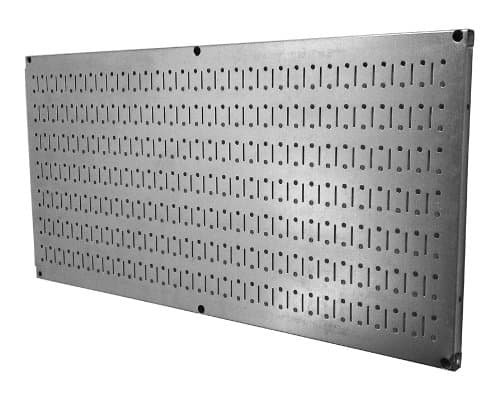 If hooks are the point Wall Control 16in x 32in Metal Pegboard Panel Metal pegboard, and the hook is the system rather than an accessory. | Hand tools you want to rearrange often, on any wall | 200 lb / panelInstall doc | |
| 4 | 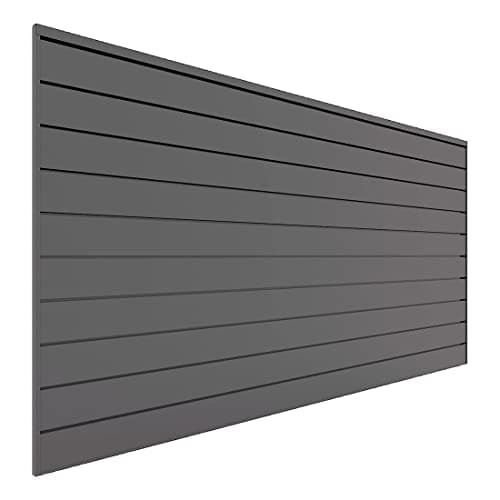 If you want a panel, not a rail Proslat PVC Slatwall Panels Continuous hook placement across the whole wall, at a price. | A full wall done once, on a normal stud-framed garage | 75 lb / sq ftInstall doc |
#ad We earn a commission if you buy through this link, at no extra cost to you. How this site is funded. Prices last checked October 21, 2026.
FastTrack is a rail, not a panel. A steel channel screws horizontally across the studs and everything — hooks, baskets, shelves, bike racks — hangs off that one line. It is the cheapest way to turn a bare garage wall into hanging storage, and it is the system most often recommended to people who ask about slatwall without knowing what slatwall costs.
It also publishes its capacity in a unit nothing else on this site uses, which is the reason this page exists.
A fifth unit of measurement
This site’s standing complaint about garage wall systems is that published load ratings arrive in four incompatible units: per square foot, per linear foot, per panel and per cabinet. FastTrack adds a fifth — per rail — and it is the least comparable of the lot, because a rail is not an area, a length you can divide, or a discrete product with a fixed footprint. It is a line across your wall whose capacity depends on how many studs it caught.
Each manufacturer's own published figure, in the unit that manufacturer chose. Read 2 September and 6 September 2026.
| System | Published rating | Unit | Fixing stated? |
|---|---|---|---|
| Rubbermaid FastTrack rail | 1,750 lb | per 48″ rail | Yes — studs, 16″ or 24″ |
| FastTrack accessories | 25–50 lb | per hook | Not published — no load distance |
| Gladiator GearTrack | 75 lb | per linear ft | Yes — studs or drywall over studs |
| Gladiator GearWall panel | 50 lb | per sq ft | Not published |
| Proslat PVC slatwall | 75 lb | per sq ft | Yes |
The top two rows are the same product. That is the finding. Rubbermaid publishes a structural figure for the steel channel and a working figure for the things you actually hang on it, and the two differ by a factor of thirty-five. Neither number is wrong; the rail really can take that load spread across four studs. But no garage reaches it, because the load has to arrive through hooks rated at 50 lb.
35×
How many 50 lb hooks a single 48 inch FastTrack rail would need to carry before the rail's own 1,750 lb rating became the binding constraint. The rail is not the limit. The hook is.
What Rubbermaid gets right
Two things, and the first is unusual enough to be worth naming. FastTrack publishes how it must be fixed: into wall studs at 16 or 24 inch spacing, with the rail beginning and ending on a stud, and the install guidance explicitly warns against relying on drywall anchors for heavy loads. Most of this category publishes a capacity figure and says nothing at all about the fastener it assumes. Rubbermaid says it out loud.
The second is footprint. A rail takes a few inches of wall height and leaves the rest of the wall alone. A slatwall panel field commits the whole surface, costs several times more, and has to be cut around outlets and light switches. If the goal is to get rakes, bikes and extension cords off the floor, a rail does that for a fraction of the money and a fraction of the Saturday.
Rubbermaid FastTrack Garage Rail
Rubbermaid · FastTrack Garage Hang Rail
#ad We earn a commission if you buy through this link, at no extra cost to you. How this site is funded. Prices last checked October 21, 2026.
The largest published number on this site and the least useful one. Rubbermaid rates the 48 inch rail at 1,750 lb into studs, then rates the hooks that hang on it at 25 to 50 lb each. You will meet the hook limit roughly thirty-five times before you meet the rail limit once.
- Load distance:
- not stated by the manufacturer, so treat the figure as a flat-against-the-wall number
- Fastening:
- Into wall studs at 16" or 24" spacing; the rail must begin and end on a stud
Published as up to 1,750 lb for the 48 inch rail when properly installed into studs. The install guide warns against relying on drywall anchors for heavy loads.
- Published rating
- 1,750 lb totalInstall doc
- Secondary rating
- 50 lb totalManufacturer
- Dimensions
- Rails sold in 32", 48" and 84" lengthsManufacturer
- Steel gauge
- Not published — this manufacturer does not state one
- Thickness
- Not published
- Material
- Not published
- Coverage
- Not published
- Warranty
- Not published
- States the stud spacing it supports and that the rail must begin and end on a stud
- Warns explicitly against relying on drywall anchors for heavy loads
- Sold everywhere, so accessories are easy to add one at a time
- A rail occupies a few inches of wall rather than a whole panel field
- The headline 1,750 lb rail rating is unreachable through 25-50 lb hooks
- No load distance published for any accessory
- Hooks are the whole system; the rail on its own stores nothing
- Accessory range is narrower than Gladiator's
Buy it for what it is: a hanging rail with a wide, cheap, everywhere- stocked accessory range. Rails come in 32, 48 and 84 inch lengths, and the longer rail is the better value per foot of wall as long as your studs line up with it.
The one thing to internalize before ordering is that the rail is not the product — the hooks are. Budget for them properly. A bare rail stores nothing, and the difference between a 25 lb non-locking hook and a 50 lb locking one is the difference between hanging a hose and hanging a bike.
Gladiator 4' GearTrack Channels (2-Pack)
Gladiator · GearTrack Channels
#ad We earn a commission if you buy through this link, at no extra cost to you. How this site is funded. Prices last checked October 21, 2026.
Rated 75 lb per LINEAR foot while Gladiator's own GearWall is rated 50 lb per SQUARE foot. Convert the channel's 6 inch height and the rail works out at roughly 150 lb per square foot of wall it occupies — three times the panel, from the same brand, hidden entirely by the change of unit.
- Load distance:
- not stated by the manufacturer, so treat the figure as a flat-against-the-wall number
- Fastening:
- Bare wood studs, or drywall over wood studs
Published as 'Holds up to 75 lbs. per linear foot' — a different unit from the GearWall panel sold alongside it.
- Published rating
- 75 lb / linear ftManufacturer
- Dimensions
- Not published
- Steel gauge
- Not published — this manufacturer does not state one
- Thickness
- Not published
- Material
- Not published
- Coverage
- Not published
- Warranty
- Not published
- Highest normalized capacity of any Gladiator wall product
- Mounting substrate is stated: bare studs or drywall over studs
- Shares the Gladiator accessory range with GearWall
- Rated in a unit that cannot be compared to anything else without converting it
- Covers a 6 inch band of wall, not a full panel field
The direct competitor, and the more comparable figure. 75 lb per linear foot across a 6 inch channel works out at roughly 150 lb per square foot of the wall it occupies — a normalized number you can hold against a panel system, which the FastTrack rail figure cannot give you.
Gladiator also states the substrate: bare wood studs, or drywall over wood studs. Between these two rails the deciding factor is usually the accessory range rather than the rating, and Gladiator’s is the larger of the two.
Where it falls down
- States the stud spacing it supports and that the rail must start and end on a stud
- Warns explicitly against relying on drywall anchors for heavy loads
- Occupies inches of wall rather than committing the whole surface
- Cheapest credible route from bare drywall to hanging storage
- Accessories are stocked everywhere and bought one at a time
- The headline rail rating is unreachable through 25-50 lb accessories
- No load distance published for any hook, which is what actually loads the fastener
- Published in a unit that cannot be compared to any panel system
- A rail gives you one line of hanging height, not a full wall field
- Accessory range is narrower than Gladiator's
Who should buy it
Buy FastTrack if the wall is drywall over wood studs, the budget is modest, and what you need is a line of hooks rather than a wall of them. It is the right answer far more often than the internet suggests, and the money saved against a panel system buys a lot of hooks.
Do not buy it if you want hook placement anywhere on the wall rather than along one line — that is what slatwall is for, and the trade is covered in slatwall versus pegboard versus French cleat. Do not buy it if the wall is bare masonry, since the whole rating assumes studs. And do not buy it expecting the 1,750 lb number to mean anything to you in practice; the honest ceiling is the sum of the hooks, and every one of those is published at 50 lb or less. For the full cross-brand picture, the normalized capacity table puts all of these figures in one unit. The rail decision itself — FastTrack against Gladiator GearTrack, compared by the hook — is made in GearTrack vs FastTrack.
Common questions
How much weight can a Rubbermaid FastTrack rail hold?
Does FastTrack have to be screwed into studs?
Is FastTrack better than slatwall?
Can you use FastTrack hooks on Gladiator GearTrack?
Sources
- Rubbermaid FastTrack hang rail — 1,750 lb per 48 in rail, stud spacing, hook ratings
- Rubbermaid FastTrack rail garage kit — kit contents and accessory limits
- Gladiator GearTrack channels — 75 lb per linear foot, substrate stated
- Gladiator GearWall panels — 50 lb per square foot
Figures were read on the dates shown against each source. If one has changed, or if we have got something wrong, tell us and we will correct the page.
Read next
- SlatwallSlatwall vs pegboard vs French cleatCost, capacity, install time, accessory lock-in and moisture behavior across all three systems in one table.
- SlatwallHow much weight can slatwall actually hold?The full cross-brand load table, normalized into one unit, with what each rating assumes stated beside it.
- SlatwallThe best garage wall systemsNine wall systems ranked on normalized load rating and on how honestly each manufacturer documents it.
- SlatwallGladiator GearTrack vs Rubbermaid FastTrackThe two garage track systems compared by the hook, since the rail ratings are in units that cannot be compared directly.