Garage cabinets vs shelving
You are paying several times more per foot for a door. Here is what it buys.
#ad We earn a commission if you buy through this link, at no extra cost to you. How this site is funded. Prices last checked October 17, 2026.
Quick picks
Cabinet picks for the enclosed run. Shelving is covered in the racks section, which is where the shelving comparisons live.
| # | Product | Best for | Published rating | Buy |
|---|---|---|---|---|
| 1 | 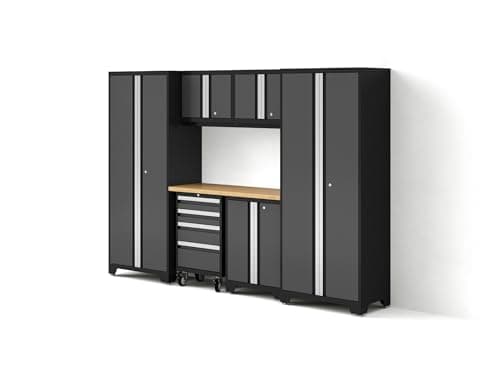 If you want cabinets NewAge Bold Series Garage Cabinet Set 24-gauge welded with 200 lb shelves behind doors. | A full wall run where you want published construction specs | 600 lb totalManufacturer | |
| 2 | No photo Cabinets, easier access Gladiator Ready-to-Assemble Large GearBox Flat-packed and stocked everywhere, 450 lb per unit. | Matching an existing Gladiator wall system for a consistent look | 450 lb totalManufacturer |
#ad We earn a commission if you buy through this link, at no extra cost to you. How this site is funded. Prices last checked October 17, 2026.
What you are actually paying for
A steel garage cabinet and a steel shelving unit of the same footprint are not remotely the same price, and the difference is almost entirely the door and the carcass around it. So the question is not “which is better” but “is the door worth it for this stuff.”
Four things a door actually does:
- Keeps dust off. Garages are dusty in a way houses are not — brake dust, concrete dust, whatever blows in when the door is open. Anything with a mechanism, a fabric, or a finish you care about is better behind a door.
- Hides visual clutter. This sounds cosmetic and is actually the most-cited reason people are happy with cabinets. A wall of closed doors reads as finished; a wall of open shelves reads as everything you own, all at once, all the time.
- Locks. Chemicals, power tools and anything a child should not reach. Open shelving cannot do this at all.
- Contains a mess. A tipped can on a shelf runs onto whatever is below it. In a cabinet it stays in the cabinet.
What open shelving does better
Capacity per dollar, by a wide margin. No door, no side panels, no hinges — the money goes into the shelf and the upright. For storing plastic bins of holiday decorations, that is exactly where you want it.
Access. You can see everything at once and reach it without opening anything. For things you use weekly, that friction difference is real and it compounds — the storage you use is the storage that is easiest to use.
Flexibility. Adjustable shelving reconfigures in minutes for an awkward item. A cabinet’s internal height is bounded by its carcass forever.
Depth. Shelving comes deeper than most cabinets do, and for bulky light items — camping gear, luggage, seasonal boxes — depth is what you need and 18 inches is not enough.
The split that works
A practical allocation rather than a product comparison. It is the layout most garages converge on once they have tried the alternatives.
| Store this | Where | Why |
|---|---|---|
| Hand tools, hardware, power tools | Cabinets | Dust, theft, and things with mechanisms |
| Chemicals, paint, solvents | Cabinets, ideally lockable | Containment and keeping them out of reach |
| Bins of seasonal stuff | Open shelving | Cheap per foot; the bin is already the container |
| Camping gear, luggage, bulky light items | Open shelving, deep | Needs depth more than protection |
| Twice-a-year boxes | Overhead rack | The only space nothing else competes for |
| Long-handled tools, hoses, bikes | Wall system | Awkward shapes that will not sit on a shelf |
The one-sentence answer
If the thing has a mechanism, a lock-worthy value, or a lid that can spill, it wants a cabinet. If it is already in a box, it wants a shelf. Almost every garage needs both, and the mistake is buying a whole wall of one because that was the page you happened to read.
Shelving specifically is covered in the shelving buying guide, and the underlying “do I need any of this” question in are garage cabinets worth it.
Common questions
Are garage cabinets better than shelves?
Is shelving cheaper than cabinets?
Should I put my tools on shelves or in cabinets?
Sources
Figures were read on the dates shown against each source. If one has changed, or if we have got something wrong, tell us and we will correct the page.
Read next
- CabinetsThe best garage cabinetsSteel gauge, per-cabinet and per-shelf capacity compared across the brands that publish them and the ones that do not.
- Planning & installAre garage cabinets worth it?The decision, committed to in the first fifty words, and the specific cases where the answer is no.
- Racks & shelvingGarage shelving buying guideDepth, per-shelf capacity, decking material and the adjustment increment that decides whether shelving fits your bins.
- Racks & shelvingBest garage storage shelvesFour shelving units ranked on published per-shelf load, including the one that drops from 4,000 lb to 500 lb on its own casters.