Garage shelving buying guide
Depth is the specification people get wrong, and it is the one that cannot be fixed later.
#ad We earn a commission if you buy through this link, at no extra cost to you. How this site is funded. Prices last checked October 17, 2026.
Quick picks
For seasonal bulk the ceiling beats any shelf. These are the overhead options worth pairing with a shelving run.
| # | Product | Best for | Published rating | Buy |
|---|---|---|---|---|
| 1 | 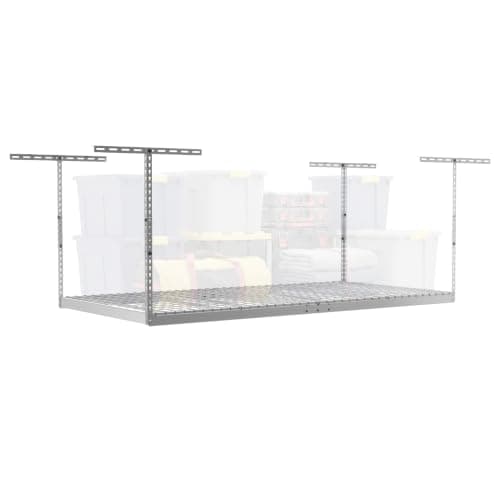 For the seasonal bulk SafeRacks 4x8 Overhead Garage Storage Rack Overhead beats any shelf for twice-a-year items. | A conventional wood-framed garage ceiling | 600 lb totalInstall doc | |
| 2 | 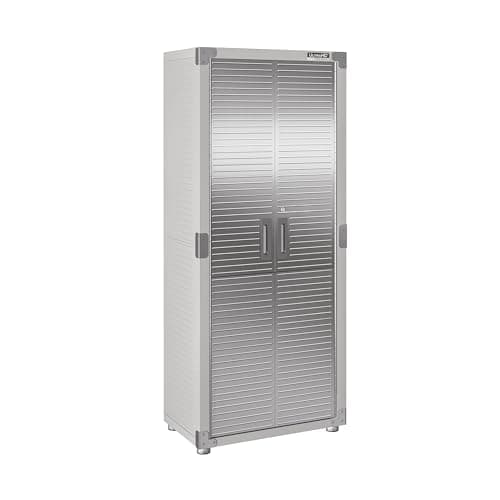 When it needs a door Seville Classics UltraHD Storage Cabinet Enclosed steel storage for anything dust would ruin. | Adding one cabinet at a time instead of committing to a full wall | 750 lb totalRetailer listing |
#ad We earn a commission if you buy through this link, at no extra cost to you. How this site is funded. Prices last checked October 17, 2026.
Shelving is the cheapest storage per cubic foot in a garage and the easiest to get wrong, because the specification that matters most — depth — is the one people pick last and cannot change afterwards.
1. Depth: measure your bins, not your wall
The standard mistake is buying 24 inch deep shelving for a garage full of 18 inch bins, which wastes six inches of depth across every shelf, or buying 18 inch shelving for 24 inch bins that then overhang and get knocked off.
Measure the actual containers you own, and buy shelving that matches them. If you have not bought the bins yet, buy those first — bins are cheap and easy to standardize, shelving is neither.
2. Capacity: per shelf, not per unit
The same rule that applies to cabinets applies here. A unit rated 2,000 lb across five shelves is telling you 400 lb per shelf, and you will not load it evenly. The per-shelf figure is the one that governs.
Be more conservative with plastic than with steel. Plastic creeps — a shelf under sustained load sags progressively over months and does not recover. A steel shelf deflects immediately and then stays put.
3. Decking: wire, solid, or particleboard
General material behavior rather than product specifications. Applies whichever brand you buy.
| Decking | Good for | Watch out for |
|---|---|---|
| Steel wire | Damp garages, dust, anything you want to see through | Small items fall through; add a liner |
| Solid steel | Heavy point loads, small loose items | Traps moisture underneath a wet item |
| Plywood on steel frame | Cheap, replaceable, easy to cut | Seal the edges or it will swell |
| Particleboard | Nothing, in a garage | Swells and sags with garage humidity; the first thing that fails |
Wire is the default recommendation for a garage. It does not trap water under a wet item, it does not hold dust, and you can see what is on the shelf above you. The one drawback — small things fall through — is solved with a cut-to-size liner or by keeping small things in bins, which you should be doing anyway.
4. Adjustment increment
The gap between shelf positions decides whether your bins fit with an inch to spare or six. Finer increments waste less vertical space across a tall unit, and over five shelves a coarse increment can cost you a whole shelf of usable height.
Check also whether adjustment is tool-free. A unit you can reconfigure in five minutes gets reconfigured when your needs change; one that needs disassembly does not.
5. Height and the ladder line
Anything above about 6 feet needs a step, and that is the same friction problem overhead storage has. Tall shelving is efficient, but treat the top shelf as overhead storage and put seasonal things there — not the things you need on a Saturday morning.
If everything you own is seasonal, an overhead rack uses space that competes with nothing at all, and is the better buy.
The buying checklist
- Measure your bins. Buy shelving to match, not the other way round.
- Read the per-shelf capacity, not the per-unit figure — the units ranked on that figure are here.
- Choose wire decking unless you have a specific reason not to.
- Check the adjustment increment and whether it is tool-free.
- Plan the top shelf as seasonal storage from the start.
- Strap tall freestanding units back to a stud — garage floors slope.
Tires are their own problem, because a tire rack carries its load out on arms rather than on a deck. That field is in best tire storage racks.
Common questions
How deep should garage shelving be?
Is wire or solid shelving better for a garage?
How much weight can garage shelving hold?
Should garage shelving be anchored to the wall?
Sources
- SafeRacks 4x8 — the overhead alternative for seasonal bulk
- NewAge Bold Series — published per-shelf capacities for comparison
Figures were read on the dates shown against each source. If one has changed, or if we have got something wrong, tell us and we will correct the page.
Read next
- Racks & shelvingWall-mounted vs freestanding garage shelvingWhich shelving approach suits a rented garage, a masonry wall, and a genuinely heavy load.
- Racks & shelvingOverhead rack vs wall shelvingThe frequency rule that decides what goes overhead and what goes on a wall, and why it matters by month three.
- CabinetsGarage cabinets vs shelvingWhat the doors actually buy you, and the case where open shelving is plainly the better answer.
- Racks & shelvingBest garage storage shelvesFour shelving units ranked on published per-shelf load, including the one that drops from 4,000 lb to 500 lb on its own casters.
- Racks & shelvingBest heavy duty garage shelvingRacks with 1,000 lb or more per shelf published, ranked on construction, with the span question none of them answers.
- Racks & shelvingBest tire storage racksSix tire racks ranked on published capacity and on the fastener spec almost none of them prints.