Wall-mounted vs freestanding garage shelving
One of these needs your wall to cooperate. The other needs your floor.
#ad We earn a commission if you buy through this link, at no extra cost to you. How this site is funded. Prices last checked October 18, 2026.
Quick picks
Both approaches need the ceiling and wall context. The overhead racks are shown for the storage that suits neither.
| # | Product | Best for | Published rating | Buy |
|---|---|---|---|---|
| 1 | 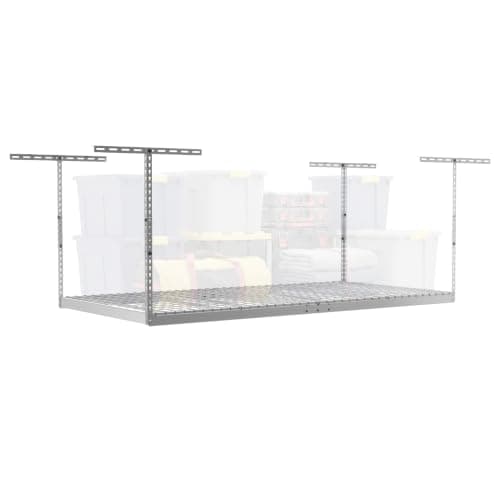 Neither — go overhead SafeRacks 4x8 Overhead Garage Storage Rack For seasonal bulk, the ceiling beats both options here. | A conventional wood-framed garage ceiling | 600 lb totalInstall doc | |
| 2 | 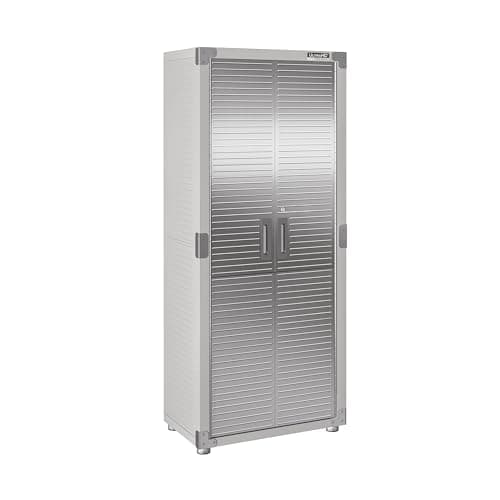 Enclosed alternative Seville Classics UltraHD Storage Cabinet If the contents want a door rather than an open shelf. | Adding one cabinet at a time instead of committing to a full wall | 750 lb totalRetailer listing |
#ad We earn a commission if you buy through this link, at no extra cost to you. How this site is funded. Prices last checked October 18, 2026.
Freestanding: fewer questions to answer
A freestanding steel shelving unit puts its load straight down through four uprights into the slab. That is the strongest and simplest load path available in a garage, and it explains why freestanding units publish the highest shelf capacities in the category — there is no fastener, no drywall, and no stud to be the weak link.
It also sidesteps three problems entirely:
- Rented garages. Nothing to fix, nothing to make good when you leave.
- Masonry walls. No anchors to size, no block webbing to worry about. Relevant to a large share of US garages, and covered in the masonry guide if you do want to fix to one.
- Not knowing where the studs are. There is no stud finder in this method.
The cost is floor. A freestanding unit occupies its footprint permanently and you cannot sweep under it, so dust, leaves and road grit accumulate along the bottom shelf where they are hardest to get at.
Wall-mounted: the floor stays yours
Wall-mounted shelving is the better answer where floor space is the constraint, which in most single- and double-car garages it is. The floor under the shelf stays usable and sweepable, the visual line of the room stays clean, and the shelf height is whatever you decide rather than whatever the manufacturer chose.
What it depends on is the wall cooperating. Every meaningful capacity assumes fixing into studs. Wall Control publishes the scale of the penalty for not doing so on its own product: 200 lb per panel into studs against 100 lb into drywall anchors, a straight halving from the fixing alone. The same principle governs a shelf bracket.
A structural comparison rather than a product one — the trade is the same whichever brand you buy.
| Freestanding | Wall-mounted | |
|---|---|---|
| Load path | Straight into the slab | Through fasteners into studs |
| Needs studs | No | Yes, for any real load |
| Works on masonry | Yes, with no fixings | Only with correctly sized anchors |
| Floor underneath | Occupied permanently | Free and sweepable |
| Height flexibility | Fixed by the unit | Whatever you choose |
| Suits a rental | Yes | Leaves holes |
| Moves with you | Yes, easily | Unbolt and make good |
How to choose
Freestanding if you rent, if the wall is masonry and you would rather not anchor into it, if the load is genuinely heavy, or if you might rearrange the garage next year.
Wall-mounted if floor space is what you are trying to reclaim, if you want to sweep the whole floor, and if you have wood studs to fix to.
And for anything you only need twice a year, neither — put it overhead, where it competes with nothing.
Common questions
Is freestanding or wall-mounted garage shelving better?
Can you put garage shelving on a block wall?
Do freestanding shelves need to be anchored to the wall?
Sources
- Wall Control — 200 lb into studs vs 100 lb into drywall anchors
- SafeRacks 4x8 — the overhead alternative to both
Figures were read on the dates shown against each source. If one has changed, or if we have got something wrong, tell us and we will correct the page.
Read next
- Racks & shelvingGarage shelving buying guideDepth, per-shelf capacity, decking material and the adjustment increment that decides whether shelving fits your bins.
- Racks & shelvingOverhead rack vs wall shelvingThe frequency rule that decides what goes overhead and what goes on a wall, and why it matters by month three.
- Planning & installMounting into drywall, studs and masonryThe substrate case nobody else covers: what happens to a published rating when the wall is block rather than studs.
- Racks & shelvingBest garage storage shelvesFour shelving units ranked on published per-shelf load, including the one that drops from 4,000 lb to 500 lb on its own casters.
- Racks & shelvingBest heavy duty garage shelvingRacks with 1,000 lb or more per shelf published, ranked on construction, with the span question none of them answers.