Garage cabinets on wheels
Mobility costs you capacity and a wall fixing. Sometimes that is the right trade.
#ad We earn a commission if you buy through this link, at no extra cost to you. How this site is funded. Prices last checked October 16, 2026.
Quick picks
Fixed cabinets shown for comparison — the trade against a rolling unit is what this page is about.
| # | Product | Best for | Published rating | Buy |
|---|---|---|---|---|
| 1 | 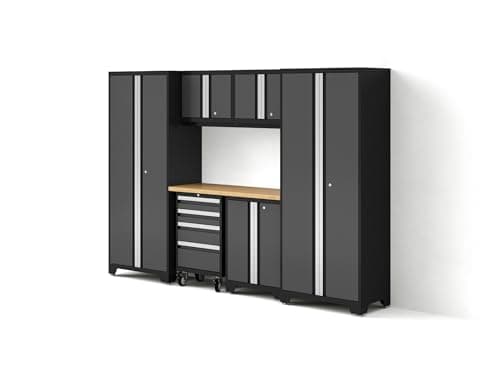 The fixed alternative NewAge Bold Series Garage Cabinet Set 600 lb per cabinet if the storage does not need to move. | A full wall run where you want published construction specs | 600 lb totalManufacturer | |
| 2 | No photo Mobile with a work surface Seville Classics UltraHD Rolling Workbench Drawers and casters, so the bench comes to the job. | A bench that has to double as the tool storage | Not published |
#ad We earn a commission if you buy through this link, at no extra cost to you. How this site is funded. Prices last checked October 16, 2026.
What you give up
Capacity. A rolling cabinet carries its whole load through four casters into a floor, rather than spreading it through a base onto a slab or into a wall. Published ratings for rolling units sit well below fixed ones — NewAge publishes 320 lb for the Bold XL rolling tool cabinet against 700 lb for a fixed base cabinet in the same range.
Wall mounting. Obviously, but worth stating: a mobile cabinet occupies floor permanently. If the point of the project was to reclaim floor space, every rolling unit works against it.
Stability when loaded high. Weight up top plus wheels equals a tipping risk, particularly on the slope every garage floor has toward the door. Load rolling cabinets bottom-heavy and lock the casters before opening a full drawer.
What you get
The tools come to the job. If you work on a car, the difference between walking to a fixed cabinet and rolling the cabinet to the wheel arch is the difference between doing the job and putting it off. For anyone whose work happens in a specific spot that is not against a wall, this is the whole argument and it is a good one.
You can clear the floor. A rolling unit can be pushed against a wall when the garage needs to hold two cars and pulled out when it does not. A fixed run cannot flex like that.
It moves house with you without unbolting anything.
The specification that actually decides it: casters
Three other caster details worth checking:
- How many lock. Two locking casters is the common arrangement and it is enough. Zero is not.
- Swivel versus fixed. Two fixed and two swivel tracks straight and steers predictably. Four swivel is maneuverable in tight space and wanders when you push it.
- Wheel material. Hard plastic is loud, transmits every crack, and can mark a coated floor. Rubber or polyurethane rolls quieter and treats the floor better.
The arrangement that works best
Most garages are better served by a fixed run plus one rolling unit than by either alone. The fixed run holds the bulk against a wall where it belongs; the rolling unit carries the tools for whatever you are currently doing to wherever you are doing it.
If the mobile unit is also going to be a work surface, a rolling workbench with drawers does both jobs and is usually the better buy than a rolling cabinet with a lid.
Common questions
Are rolling garage cabinets stable enough?
How much weight can a rolling garage cabinet hold?
What size casters do garage cabinets need?
Sources
Figures were read on the dates shown against each source. If one has changed, or if we have got something wrong, tell us and we will correct the page.
Read next
- CabinetsThe best garage cabinetsSteel gauge, per-cabinet and per-shelf capacity compared across the brands that publish them and the ones that do not.
- WorkbenchesWorkbench vs cabinet runWhy a worktop on cabinets is not a workbench, and which one should get the best wall.
- WorkbenchesTool chests vs garage cabinetsWhy drawers and cabinets are not interchangeable, and what belongs in each.