What garage cabinets cost
A forty-fold price span in one category - and published construction detail that does not rise with it.
#ad We earn a commission if you buy through this link, at no extra cost to you. How this site is funded. Prices last checked October 23, 2026.
Quick picks
One cabinet per price bracket, ranked on how much published specification each dollar buys rather than on price. Every figure is the maker's own, and live prices come from the daily price check rather than from this page.
| # | Product | Best for | Published rating | Buy |
|---|---|---|---|---|
| 1 | 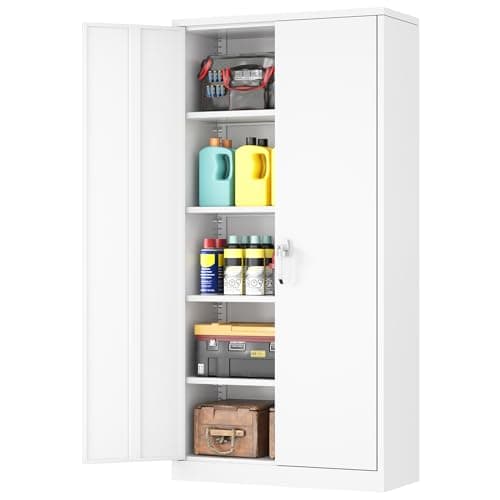 Most published spec per dollar INTERGREAT 72" Locking Steel Cabinet 0.88 mm steel stated, 180 lb a shelf, 900 lb total - in the budget bracket. | The most published detail at the lowest price | 180 lb / shelfRetailer listing | |
| 2 | 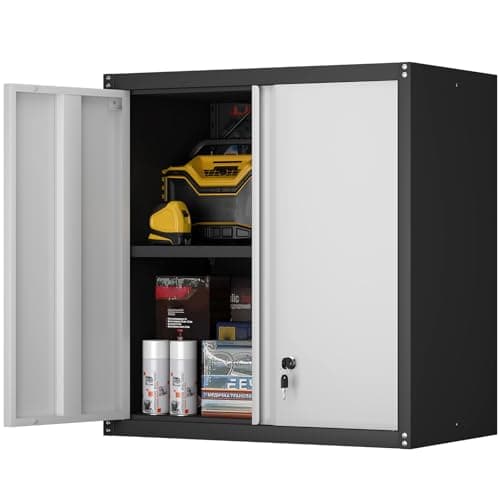 The floor, and what it costs you STEELIST Steel Wall Cabinet 120 lb a shelf published; no gauge, no thickness, one shelf. | A block or poured-concrete garage wall | 120 lb / shelfRetailer listing | |
| 3 | 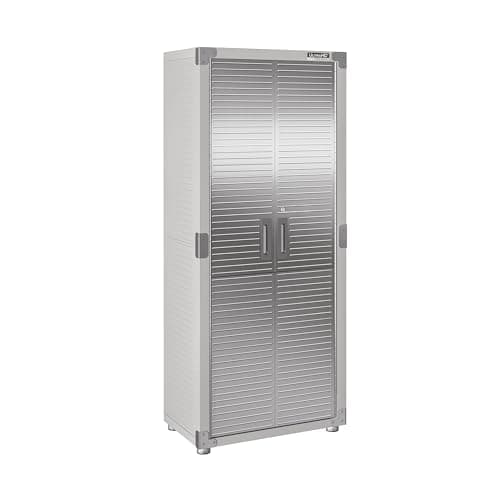 The middle bracket Seville Classics UltraHD Storage Cabinet 750 lb total and 150 lb a shelf - and no steel figure at all. | Adding one cabinet at a time instead of committing to a full wall | 750 lb totalRetailer listing | |
| 4 | 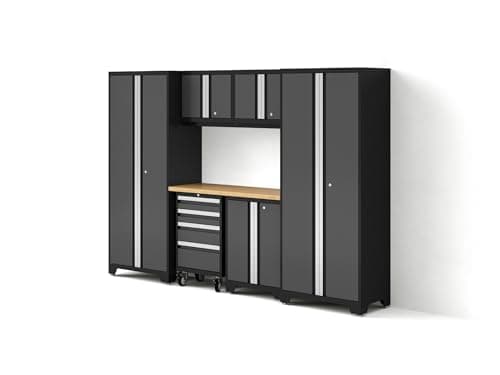 The top bracket, and what it adds NewAge Bold Series Garage Cabinet Set 24-gauge welded and 200 lb a shelf, published. Sold as a set. | A full wall run where you want published construction specs | 600 lb totalManufacturer |
#ad We earn a commission if you buy through this link, at no extra cost to you. How this site is funded. Prices last checked October 23, 2026.
This is the most-asked question about this category and the hardest one to answer with a number, because the same four words — garage storage cabinet — cover a single wall box you can carry under one arm and a welded eight-piece run that arrives on a pallet. The span between them is roughly fortyfold. What follows is what moves a cabinet along that span, and what you get at each stop.
The four things that actually move the price
One: welded or flat-packed. This is the biggest single jump. A welded carcass arrives square and stays square; a flat-packed one is square to the extent you made it square, and it is the assembly that most often gets blamed when a door stops closing two years later. Welded also costs more to ship, because you are shipping air. Almost every cabinet at the top of the range is welded and almost nothing at the bottom is.
Two: whether the steel is specified at all. Gauge or thickness is the number that governs how much the carcass flexes under a loaded shelf, and most of this category declines to publish it. When it is published it is usually as a US gauge number, except on the import-brand cabinets where it appears in millimeters, and the two scales cannot be compared without doing the arithmetic yourself.
Three: the per-shelf figure, not the total. A cabinet total is a number you will never load; you load one shelf at a time. The spread on the published per-shelf figure across the brackets below is wider than the spread on price, which is the single most useful thing on this page.
Four: depth. Eighteen inches is the category default and twenty-four is the upgrade, and the deeper line is dearer per cabinet before you have added a single feature. It is also the dimension people most often regret in both directions, which is why it has its own page in garage cabinet dimensions.
What each bracket actually publishes
Here is the same four-column test applied across the brackets, using each product’s own published figures. Read the steel column down the page before you read anything else.
Each maker's own published figures, read on the dates recorded against each product in the registry. 'Not published' means the figure does not appear on the listing, which is itself the finding.
| Bracket | Per shelf | Total | Steel published | Construction |
|---|---|---|---|---|
| Entry — single wall box | 120 lb | Not published | Not published — no gauge or thickness | Flat-packed |
| Budget — 72″ locker | 180 lb | 900 lb | 0.88 mm | Flat-packed |
| Middle — commercial single | 150 lb | 750 lb | Not published — neither, on either | Flat-packed |
| Premium — welded set | 200 lb | 600 lb per cabinet | 24 gauge | Fully welded |
The finding: published detail does not track price
Read the steel column top to bottom and it goes nothing, 0.88 mm, nothing, 24 gauge. The cheapest full-height cabinet on this page publishes a steel thickness. The one costing substantially more than it publishes neither a gauge nor a thickness anywhere on its listing, despite being the best-documented cabinet in this category on every other axis. You have to climb to the welded sets before a steel figure reappears.
Price per linear foot is the unit that matters
Nobody buys one cabinet in isolation; they buy a wall. So the comparison that actually governs the bill is cost per linear foot of finished run, and it reorders things sharply. A 72 inch locker is two feet of width; a welded eight-piece set can be fifteen. Divide the price of each by the feet of wall it covers before you compare anything, because a cabinet that looks expensive per unit can be the cheaper wall and frequently is.
This is also where the store exclusives win and where we earn nothing saying so. Husky at Home Depot and Kobalt at Lowe’s are routinely the lowest cost per linear foot of steel cabinet in the country, and neither is sold through any program we have joined, so there is no buy button for either anywhere on this site. They are compared on the same terms as everything else in the store-brand comparison.
Doing that arithmetic needs one measurement and one division. Measure the wall you will actually line, minus the door swing and anything you are not covering, then divide by the width of the cabinet you are pricing — the full-height units here run roughly 26 to 32 inches wide, so call it two and a half feet each and round down rather than up, because a cabinet that does not fit is worse than a gap. A twelve foot bay takes four to five of them; a single-car side wall is usually three. Multiply that count by the live price beside each pick and you have the real bill, which is almost always a larger number than the one people have in mind when they start looking.
The line items that land after the cabinet
Four costs show up late and none of them is on the product page. Anchoring hardware, because a tall cabinet wants fixing to the structure and the fastener depends on whether the wall behind it is studs or masonry — a distinction that changes the hardware entirely and is set out in mounting to drywall versus masonry. Leveling, because a garage slab slopes to the door by design, and a cabinet run that is not shimmed level has doors that swing themselves shut.
Assembly time, and a second person. A flat-packed full-height cabinet is an afternoon and genuinely easier with two people; a welded one needs two people to carry but no assembly at all. And delivery, which on welded sets can be a freight item rather than a parcel — worth checking before the bracket comparison feels settled, because it can close a gap that looked decisive.
Where the money is genuinely well spent
On the weld, if you are buying a run you intend to keep: it is the one thing you cannot add later and the one failure mode that assembly skill cannot compensate for. On depth, if and only if you have measured the deepest thing you own and the space a car door needs. And on a published per-shelf figure, because it is the number you will actually plan against — a cabinet that states 200 lb a shelf is a different proposition from one that states a total and leaves you dividing.
Where it is not well spent: on a brand name that publishes less than its cheaper rivals, which in this category happens more than you would expect. Our premium cabinets page works through what the top bracket does and does not add, and cheap garage cabinets ranks the discount end on published capacity per dollar rather than on price tag. This page is the bracket map; those two are the shortlists inside it.
The picks, one per bracket
INTERGREAT 72" Locking Steel Cabinet
INTERGREAT · ITWHITE93711 Metal Storage Cabinet
#ad We earn a commission if you buy through this link, at no extra cost to you. How this site is funded. Prices last checked October 23, 2026.
The most disclosure per dollar on this page: a published steel thickness of 0.88 mm, 180 lb a shelf, 900 lb total, and the only listing here that names the reason for the holes in its back panel - so the cabinet cannot topple.
- Load distance:
- not stated by the manufacturer, so treat the figure as a flat-against-the-wall number
- Fastening:
- Per layer; two pre-drilled holes in the back for wall fixing
Published as "180 pounds per layer, up to a maximum of 900 lbs". The listing also states two pre-drilled holes in the back panel for mounting to the wall, expressly to avoid the cabinet toppling over.
- Published rating
- 180 lb / shelfRetailer listing
- Secondary rating
- 900 lb totalRetailer listing
- Dimensions
- 72" H x 32" W x 16" D; four adjustable shelves behind two doorsRetailer listing
- Steel gauge
- Not published — this manufacturer does not state one
- Thickness
- 0.88 mm cold-rolled steelRetailer listing
- Material
- Not published
- Coverage
- Not published
- Warranty
- Not published
- Publishes a steel thickness, which most of this category does not
- 180 lb per shelf and a 900 lb maximum, both stated
- Names the anti-tip purpose of the two mounting holes in its back
- Lowest price bracket on this page
- 16 inches deep, the shallowest cabinet here
- Four shelves rather than five, so fewer levels than its rivals
- Two mounting holes is the whole of the published fixing detail
- Assembly required, on a 72 inch flat-packed steel box
It leads a cost page for one reason: it publishes a steel thickness — 0.88 mm cold-rolled — which almost nothing at or near its price does, alongside 180 lb a shelf and a 900 lb total. It also names the purpose of the two pre-drilled holes in its back panel, which is anti-tip fixing, and that is a sentence most of this bracket does not write.
The honest limits: it is the shallowest full-height cabinet here at 16 inches, so usable volume is smaller than the 18 and 24 inch boxes; two mounting holes is the entire published fixing detail, with no fastener or stud spacing; and it is flat-packed, which on a 72 inch steel cabinet is an afternoon and a second pair of hands.
STEELIST Steel Wall Cabinet
STEELIST · Wall cabinet-04 Steel Wall Cabinet
#ad We earn a commission if you buy through this link, at no extra cost to you. How this site is funded. Prices last checked October 23, 2026.
The only listing on this page that names the fastener and the wall it is for: supplied expansion bolts, for concrete, brick or solid studs. That is the sentence every other maker leaves out, and it is worth more than another 30 lb of claimed shelf capacity.
- Load distance:
- not stated by the manufacturer, so treat the figure as a flat-against-the-wall number
- Fastening:
- Per shelf; pre-drilled back panel with supplied expansion bolts for concrete, brick or solid studs
Published as 120 lb per shelf. Alone among the cabinets compared here, the listing states both the fastener supplied and the substrates it is meant for.
- Published rating
- 120 lb / shelfRetailer listing
- Dimensions
- 25.98" W x 27.95" H x 13.78" D; one removable, adjustable shelfRetailer listing
- Steel gauge
- Not published — this manufacturer does not state one
- Thickness
- Not published
- Material
- Steel, powder-coatedRetailer listing
- Coverage
- Not published
- Warranty
- Not published
- The only listing here that names its fastener and the walls it suits
- 120 lb per shelf published
- Removable, height-adjustable shelf
- Lowest price bracket on this page
- No capacity published for the cabinet as a whole
- Expansion bolts are for masonry - a stud wall needs different fasteners
- 26 inches wide, the narrowest cabinet here
- No steel gauge published
The entry point: a single wall-hung box at the lowest price of any cabinet on this site, publishing 120 lb for its one adjustable shelf and naming both its fastener and the substrates it can be fixed to — which, at this price, is more disclosure than the bracket usually offers.
What the low price costs you is specification and volume. No gauge and no thickness are published anywhere, there is one shelf rather than four, and at roughly 26 inches wide and 14 deep it is a cupboard rather than a storage wall. Buy it to get one shelf of lockable storage onto a wall cheaply, not as the first unit of a run.
Seville Classics UltraHD Storage Cabinet
Seville Classics · UltraHD Storage Cabinet
#ad We earn a commission if you buy through this link, at no extra cost to you. How this site is funded. Prices last checked October 23, 2026.
The commercial-grade middle option, and the best documented steel cabinet we can link: 750 lb total and 150 lb per shelf on a 30 by 18 by 72 inch body, behind stainless doors on a three-point lock. Sold as single units rather than a set, so a wall can be built up one cabinet at a time.
- Load distance:
- not stated by the manufacturer, so treat the figure as a flat-against-the-wall number
- Fastening:
- Total, on four leveling feet with rubber base pads
Published as a total weight capacity of 750 lb (150 lb per shelf) for the 30 in. model. Four shelves are supplied, so the published total is larger than four shelves at their own rating.
- Published rating
- 750 lb totalRetailer listing
- Per shelf
- 150 lb / shelfRetailer listing
- Dimensions
- 30" W x 18" D x 72" H exterior; 27" W x 17.13" D x 67.6" H interiorRetailer listing
- Steel gauge
- Not published — this manufacturer does not state one
- Thickness
- Not published
- Material
- Powder-coated solid steel with stainless-steel doorsRetailer listing
- Coverage
- Not published
- Warranty
- Not published
- Publishes a total AND a per-shelf figure, which most steel cabinets do not
- Three-point lock described in detail: top, middle and base, two keys
- Sold as single units, so a wall can be built up over time
- Leveling feet with rubber pads, for a garage slab that is never flat
- Capacities are published per model, not range-wide, so they need checking one by one
- No published steel gauge or thickness anywhere on the listing
- Nothing published about anchoring a 72 inch cabinet to the wall
- Narrower than the budget lockers that cost a third as much
The best-documented steel cabinet we can link on every axis except the one this page is about: 750 lb total AND 150 lb per shelf, both published, behind stainless doors on a three-point lock described in detail, sold as single units so a wall can be built up over time rather than bought at once.
And it publishes no steel gauge and no thickness at all, which on a page reading the steel column down the brackets is conspicuous — the cabinet below it in price states a thickness and this one does not. No load distance is given with the 150 lb either, and nothing in the published material addresses anchoring a 72 inch cabinet to the wall.
NewAge Bold Series Garage Cabinet Set
NewAge Products · Bold Series
#ad We earn a commission if you buy through this link, at no extra cost to you. How this site is funded. Prices last checked October 23, 2026.
The cabinet range that publishes the most. NewAge states 24-gauge steel and fully-welded construction on the product page, plus per-cabinet and per-shelf capacities. Gladiator, its closest rival, publishes no gauge at all — and gauge is the single number that separates a cabinet that stays square from one that racks.
- Load distance:
- not stated by the manufacturer, so treat the figure as a flat-against-the-wall number
- Fastening:
- Base cabinet, total capacity
NewAge publishes a capacity per cabinet type: 800 lb lockers, 600 lb base cabinets, 100 lb wall cabinets.
- Published rating
- 600 lb totalManufacturer
- Per shelf
- 200 lb / shelfManufacturer
- Dimensions
- 180" W x 18" D x 76.75" H (8-piece set)Manufacturer
- Steel gauge
- 24 gauge steel, fully weldedManufacturer
- Thickness
- Not published
- Material
- Not published
- Coverage
- Not published
- Warranty
- Not published
- Publishes steel gauge, which its main competitor does not
- Ships fully welded, so there is no assembly-square to get wrong
- 200 lb adjustable shelves against Gladiator's 75 lb
- 18 inch depth is shallow for larger power tools — the XL range is 24 inch
- Welded cabinets are heavy and awkward to move once placed
What the top of the market actually buys, stated in the only terms worth paying for: 24-gauge steel, fully welded, with 200 lb per shelf published — the highest per-shelf figure in this comparison and roughly a third more than the budget locker that publishes thicker steel. Welded means it arrives square and stays square, which is the one property no amount of careful assembly can replicate.
It is sold as a multi-piece set rather than a single cabinet, so the entry cost is a wall rather than a box, and that set price is where most of the fortyfold span on this page comes from. Twenty-four gauge is also thinner than the budget locker’s published millimeters once converted, so you are paying for the weld, the warranty and the finish rather than for more steel.
- You want welded, because it is the one thing that cannot be added later
- You have measured and genuinely need 24 inches of depth
- You want a published per-shelf figure to plan a load against
- The run is permanent and a warranty is worth something to you
- The next bracket up publishes less about its steel than the one below it
- You are paying per cabinet for a wall the store brands cover for less per foot
- The deeper line is dearer before a single feature is added
- A total capacity is being quoted at you instead of a per-shelf figure
If the question behind the budget is the whole garage rather than the cabinets, the three-tier version of this analysis across every storage category is in what garage storage costs, and the overhead equivalent — where the rack is genuinely not the cost — is in overhead storage cost.
Common questions
How much do garage cabinets cost?
Are expensive garage cabinets worth it?
What makes one garage cabinet cost more than another?
What is the cheapest way to get a wall of garage cabinets?
What costs show up after you buy the cabinets?
Sources
- INTERGREAT 72 in locking steel cabinet - 0.88 mm cold-rolled steel, 180 lb per layer, 900 lb max
- STEELIST steel wall cabinet - 120 lb per shelf, fastener and substrates named
- Seville Classics UltraHD storage cabinet - 750 lb total, 150 lb per shelf, three-point lock
- NewAge Bold Series 8-piece set - 24 gauge fully welded, 200 lb per shelf
Figures were read on the dates shown against each source. If one has changed, or if we have got something wrong, tell us and we will correct the page.
Read next
- CabinetsCheap garage cabinetsThe discount cabinet bracket ranked on what each publishes, by a site that earns nothing on half of them.
- CabinetsPremium garage cabinetsUpgrade-tier cabinet ranges compared on published gauge, weld and warranty - the things capacity figures do not tell you.
- Planning & installWhat garage storage actually costsThe three budget tiers, what each one buys, and the costs that never appear in a product comparison.
- CabinetsMetal garage cabinetsThe five specs that decide a steel cabinet purchase, and which brands publish them.
- CabinetsThe best garage cabinetsSteel gauge, per-cabinet and per-shelf capacity compared across the brands that publish them and the ones that do not.
- Planning & installStandard garage cabinet dimensionsDepths, widths, heights and clearances, with the published figures from two manufacturers' actual sets.