Garage cabinets and workbench
Two products, one wall, and one dimension that has to agree between them.
#ad We earn a commission if you buy through this link, at no extra cost to you. How this site is funded. Prices last checked October 22, 2026.
Quick picks
Ranked on published capacity and on how well each product works as part of a run rather than as a standalone purchase.
| # | Product | Best for | Published rating | Buy |
|---|---|---|---|---|
| 1 | No photo Best bench for a run Seville Classics UltraHD Adjustable Height Workbench 2,000 lb top and 28.5 to 42 inch height, so it can match any cabinet. | One bench that has to suit both seated and standing work | 2,000 lb totalManufacturer | |
| 2 | 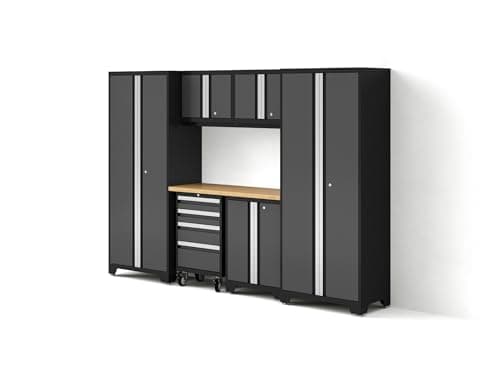 Best cabinets to build around NewAge Bold Series Garage Cabinet Set 600 lb base cabinets, 200 lb shelves, and a worktop in the larger sets. | A full wall run where you want published construction specs | 600 lb totalManufacturer | |
| 3 | No photo Best flat-packed pairing Gladiator Ready-to-Assemble Large GearBox 450 lb per unit and arrives in cartons, so the run can grow. | Matching an existing Gladiator wall system for a consistent look | 450 lb totalManufacturer | |
| 4 | No photo If the brands must match Gladiator Hardwood Top Workbench A hardwood top from the same range as the cabinets. | Visual consistency with an existing Gladiator wall and cabinet run | Not published |
#ad We earn a commission if you buy through this link, at no extra cost to you. How this site is funded. Prices last checked October 22, 2026.
“Garage cabinets and workbench” is one of the most-searched phrases in this category and one of the least well served, because almost everything written about it is a product list. It is not a shopping problem. It is a layout problem with a shopping problem attached, and the layout half decides whether the result is a workshop or an expensive wall of doors.
Fix the height first
Everything on this wall is stacked around one horizontal line: the top of the work surface. Get that wrong and the cabinets above it are either unreachable or in the way of your elbows, and no amount of capacity fixes it.
Standard dimensions across the ranges covered on this site, with the published bench range from Seville.
| Element | Typical dimension | Why it is that |
|---|---|---|
| Worktop height | 34–38″ | Standing work. Seville publishes 28.5 to 42 inches adjustable, which covers seated work at the low end. |
| Clearance above the top | ~18″ | Enough to stand a bottle, a battery charger or a bench grinder under the wall cabinets without moving them. |
| Base cabinet depth | 18–24″ | 18 is standard; 24 takes a miter saw without the door fouling. |
| Wall cabinet depth | 12–18″ | Shallower than the base on purpose, so you can work at the surface without hitting your head. |
| Bench length | 48–72″ | Below 48 inches a bench becomes a shelf. 60 is the common compromise. |
Two ways to build the run
A bench dropped into a cabinet run. Cabinets either side, a gap in the middle, a freestanding bench in the gap. This is the flexible option: the bench can be a different brand, a different height, and it can be pulled out or replaced without touching the cabinets. It also means the bench legs take the load rather than the cabinets, which is why the published bench capacity matters.
A worktop spanning base cabinets. No bench at all — a continuous surface laid across two or three base cabinets, which most of the larger sets include. Cleaner, stronger, and considerably cheaper per foot of surface. The cost is that you lose knee room, so you cannot sit at it, and the height is fixed by whatever the cabinets are.
For most garages the second is the right answer and the first is the one people buy. If you do any work seated — small engine repair, electronics, anything with a magnifier — the freestanding bench earns its place. If you do not, the worktop over cabinets gives you more storage and more surface for the money. The either/or is examined in more detail in workbench versus cabinet run.
Seville Classics UltraHD Adjustable Height Workbench
Seville Classics · UltraHD Height Adjustable Workbench
#ad We earn a commission if you buy through this link, at no extra cost to you. How this site is funded. Prices last checked October 22, 2026.
2,000 lb published capacity on a 60 by 24 inch top, height adjustable from 28.5 to 42 inches in 1 inch increments. The adjustment range is the reason to buy it: it covers seated work at one end and standing assembly at the other, which no fixed bench does.
- Load distance:
- not stated by the manufacturer, so treat the figure as a flat-against-the-wall number
- Fastening:
- Distributed across the work surface
- Published rating
- 2,000 lb totalManufacturer
- Dimensions
- 60" W x 24" D, height 28.5" to 42" in 1" incrementsManufacturer
- Steel gauge
- Not published — this manufacturer does not state one
- Thickness
- 1.5" solid polyurethane-coated wood topManufacturer
- Material
- Commercial-grade steel frame, solid wood topManufacturer
- Coverage
- Not published
- Warranty
- Not published
- 2,000 lb published capacity, the highest of any bench here
- 28.5 to 42 inch adjustment in 1 inch increments covers every working height
- 1.5 inch solid wood top takes a beating and can be resurfaced
- Steel gauge is not published, only 'commercial-grade steel'
- Heavy enough that height adjustment is a two-person job once loaded
The reason this is the pick for a mixed run is the adjustment range: Seville publishes 28.5 to 42 inches in 1 inch increments, which means the bench can be set to match whatever height your cabinets landed at rather than the other way round. Nothing else here does that.
The published 2,000 lb top capacity is the highest of any bench on this site. The practical caveat is that height adjustment on a loaded bench is a two-person job, so set it before you fill it, and check it against the cabinet tops with a straightedge rather than a tape.
NewAge Bold Series Garage Cabinet Set
NewAge Products · Bold Series
#ad We earn a commission if you buy through this link, at no extra cost to you. How this site is funded. Prices last checked October 22, 2026.
The cabinet range that publishes the most. NewAge states 24-gauge steel and fully-welded construction on the product page, plus per-cabinet and per-shelf capacities. Gladiator, its closest rival, publishes no gauge at all — and gauge is the single number that separates a cabinet that stays square from one that racks.
- Load distance:
- not stated by the manufacturer, so treat the figure as a flat-against-the-wall number
- Fastening:
- Base cabinet, total capacity
NewAge publishes a capacity per cabinet type: 800 lb lockers, 600 lb base cabinets, 100 lb wall cabinets.
- Published rating
- 600 lb totalManufacturer
- Per shelf
- 200 lb / shelfManufacturer
- Dimensions
- 180" W x 18" D x 76.75" H (8-piece set)Manufacturer
- Steel gauge
- 24 gauge steel, fully weldedManufacturer
- Thickness
- Not published
- Material
- Not published
- Coverage
- Not published
- Warranty
- Not published
- Publishes steel gauge, which its main competitor does not
- Ships fully welded, so there is no assembly-square to get wrong
- 200 lb adjustable shelves against Gladiator's 75 lb
- 18 inch depth is shallow for larger power tools — the XL range is 24 inch
- Welded cabinets are heavy and awkward to move once placed
600 lb base cabinets, 200 lb shelves, 100 lb wall cabinets, 24-gauge welded steel — the most completely published set of numbers in the category, and the larger sets include the worktop, which removes the height-matching problem entirely.
Watch the wall cabinet figure. One hundred pounds is a sensible published limit for something hanging over a surface you stand at, and it is the reason the heavy things belong in the base cabinets. The full range is in the NewAge review.
What to buy, in what order
Buy the bench or the worktop first, not the cabinets. The surface is the thing you will use every time you go into the garage, it sets the height that everything else has to respect, and it is the purchase you are least likely to regret. Cabinets can be added a unit at a time around a bench that is already in place; a bench squeezed in later has to fit whatever gap the cabinets left.
Then base cabinets, because that is where the heavy things go and where the published capacities are highest. Then wall cabinets last, once you know what is actually living on the worktop and how much clearance it needs. Buying in that order also spreads the cost across months, which is the only reason most garages ever get finished.
- The wall has an outlet, a panel box or a window in it
- The garage is single-car and depth is contested
- You want wall cabinets above the bench rather than beside it
- You are mixing brands, which almost always means mixing heights
- You are buying one complete set with its own worktop
- The bench is going on a wall with nothing else on it
- You have more wall than you have things to put on it
The mistakes that cost the most
Matching the depths. Wall cabinets should be shallower than base cabinets. If they are not, the wall cabinet overhangs the working area and you cannot stand square to the bench.
Putting the bench in the corner. A bench needs access from both ends for anything long. Corners are for cabinets and lockers, which only need a door swing.
Forgetting the outlet. A worktop with no power is a shelf. Decide where the power comes from before the cabinets cover the only outlet on that wall — several cabinets in this category have rear access ports for exactly this reason, and it is worth checking whether yours does.
Sizes and clearances for every cabinet class are in the dimensions reference, and the bench heights specifically are worked through in garage workbench height.
Common questions
What height should a garage workbench be next to cabinets?
How much clearance do I need between a worktop and wall cabinets?
Should I buy the cabinets or the workbench first?
Can I use base cabinets as a workbench?
Sources
- Seville Classics UltraHD height adjustable workbench — 2,000 lb top, 28.5-42 in range
- NewAge Bold Series support hub — 600 lb base, 100 lb wall, 200 lb shelves
- Gladiator Ready-to-Assemble Large GearBox — 450 lb/unit, 75 lb/shelf
- Harbor Freight Yukon 48" cabinet — rear power access ports listed
Figures were read on the dates shown against each source. If one has changed, or if we have got something wrong, tell us and we will correct the page.
Read next
- WorkbenchesWorkbench vs cabinet runWhy a worktop on cabinets is not a workbench, and which one should get the best wall.
- WorkbenchesThe best garage workbenchesAdjustable height, top thickness and published capacity compared, with the store-brand value option named.
- CabinetsGarage cabinet systemsWhat the four cabinet classes are rated for, which to buy first, and why piece count is the wrong comparison.