Kitchen cabinets in a garage
It is the cheapest cabinet run you will ever build, and there are exactly three reasons it goes wrong.
#ad We earn a commission if you buy through this link, at no extra cost to you. How this site is funded. Prices last checked October 22, 2026.
Quick picks
The steel alternatives, ranked on published per-shelf capacity, for the loads a kitchen cabinet will not take.
| # | Product | Best for | Published rating | Buy |
|---|---|---|---|---|
| 1 | 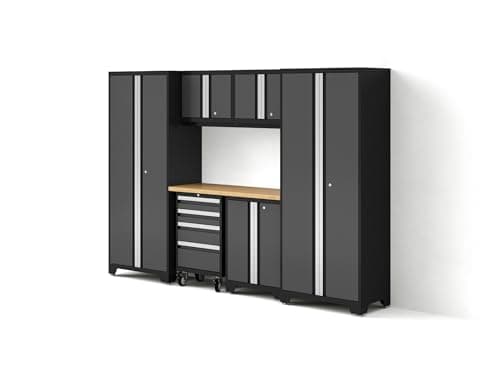 The steel answer NewAge Bold Series Garage Cabinet Set 24-gauge welded, 200 lb shelves, 600 lb base cabinets published. | A full wall run where you want published construction specs | 600 lb totalManufacturer | |
| 2 | No photo Cheaper steel, flat-packed Gladiator Ready-to-Assemble Large GearBox 450 lb per unit and 75 lb per shelf, in cartons. | Matching an existing Gladiator wall system for a consistent look | 450 lb totalManufacturer | |
| 3 | No photo If it is only weight you need Gladiator 60" Heavy Duty Garage Shelving Rack 2,000 lb per shelf, at a fraction of any cabinet price. | Bulk weight - fluids, wheels, masonry, anything a cabinet shelf refuses | 2,000 lb / shelfManufacturer |
#ad We earn a commission if you buy through this link, at no extra cost to you. How this site is funded. Prices last checked October 22, 2026.
This comes up constantly, and usually for a good reason: somebody is replacing a kitchen and has a van full of perfectly serviceable cabinets, or a home center has a clearance run at a price no garage cabinet gets near. It is a genuinely reasonable thing to do, and the internet answers it with either “sure, why not” or a lecture. Both are unhelpful.
Here is the useful version: three things change, only one of them is serious, and which one bites depends entirely on what you plan to put in them.
1. The carcass is board, not steel
Mass-market kitchen cabinets are built from particleboard or MDF with a laminate or veneer face, occasionally plywood at the higher end. Garage cabinets in this category are folded and welded steel. That is not snobbery about materials — it changes how the cabinet fails.
Steel that is overloaded deforms and keeps holding. Board that is overloaded sags at the shelf, and then the cam fittings holding the carcass square start to pull through the board face. Once a board carcass racks out of square the doors stop closing and it does not come back. That is the failure mode to plan around, and it is slow and quiet rather than dramatic.
2. The published capacity is lower, or missing
Garage cabinet makers publish per-cabinet and per-shelf figures because buyers ask. Kitchen cabinets are sold on finish, door style and price, and a per-shelf load figure is frequently not published at all. That leaves you without the one number you need for a garage, where the load is fasteners, fluids and cast iron rather than plates.
Published figures from each manufacturer, read 2, 4 and 6 September 2026. The kitchen row is what we could NOT find rather than a figure.
| Cabinet | Published per shelf | Carcass |
|---|---|---|
| Gladiator Premier 84″ | 400 lb | Welded steel |
| NewAge Bold XL | 250 lb | 24-gauge welded steel |
| NewAge Bold Series | 200 lb | 24-gauge welded steel |
| Yukon (Harbor Freight) | 90 lb | Powder-coated steel |
| Gladiator RTA Large GearBox | 75 lb | Steel, gauge not published |
| Typical kitchen wall cabinet | Not published — rarely published at all | Particleboard or MDF |
The bottom row is the point of the table. It is not a claim that kitchen cabinets are weak; it is that you cannot find out. On this site an absent figure is treated as a finding, and here the finding is that you will be guessing about the one thing that decides whether the cabinet survives.
3. The garage is not a kitchen
A kitchen is heated, ventilated and dry. A garage swings through the year, gets condensation on cold mornings, and has a concrete floor that gives up moisture. Particleboard handles that badly at the edges — the exposed bottom edge of a base cabinet and the back panel are where it starts, and once board swells it does not shrink back.
Wall cabinets fare much better than base cabinets here, simply by being off the floor and away from the worst of it. If you are going to use kitchen cabinets in a garage, using them as upper cabinets and putting something steel underneath is the single best decision available.
When it is the right call
- They are free or near-free from a kitchen refit
- They are going up as wall cabinets, not base cabinets
- The contents are light: rags, cleaning supplies, packaging, spares
- The garage is attached, insulated and reasonably dry
- The load is fluids, hand tools, fasteners or anything cast iron
- The garage is detached, unheated or gets condensation
- You want a published capacity to plan against
- The run has to take a worktop and be worked at
There is also a middle answer that gets overlooked. If what you actually need is somewhere to put heavy things, a cabinet is the expensive way to buy capacity. Open shelving publishes far higher per-shelf figures than any cabinet at a fraction of the price — Gladiator publishes 2,000 lb per shelf on a welded rack against 400 lb on its best cabinet shelf. Doors are for dust and tidiness, not for strength. That comparison is in best garage storage shelves.
If you are going to do it
Hang them high, load them light, seal the exposed bottom edges and the back panel with anything film-forming before they go up, and fix them into every stud rather than into the drywall. Keep the heavy things low, in something steel, on the floor. Done that way a kitchen cabinet run in a garage lasts for years and costs almost nothing, which is a perfectly good outcome.
Done the other way — base cabinets on a concrete floor, full of paint and power tools, in a detached garage — it fails within two winters, and it fails slowly enough that you will have filled them before you notice. Whether cabinets are worth buying at all is worked through in are garage cabinets worth it.
Common questions
Can you use kitchen cabinets in a garage?
Will particleboard cabinets survive in a garage?
How much weight can a kitchen wall cabinet hold in a garage?
How should kitchen cabinets be fixed to a garage wall?
Sources
- NewAge Bold Series support hub — 200 lb shelves, 24-gauge welded
- Gladiator Premier 84" Tall Cabinet — 400 lb per shelf
- Gladiator Ready-to-Assemble Large GearBox — 75 lb per shelf
- Harbor Freight Yukon 30 in. cabinet — 90 lb per shelf
- Gladiator 60" Heavy Duty Rack — 2,000 lb per shelf, for comparison
Figures were read on the dates shown against each source. If one has changed, or if we have got something wrong, tell us and we will correct the page.
Read next
- CabinetsHow to hang cabinets in a garageThe ledger-board method, fastener choice, and why a cabinet's rating is not your installation's rating.
- Planning & installStandard garage cabinet dimensionsDepths, widths, heights and clearances, with the published figures from two manufacturers' actual sets.
- Planning & installAre garage cabinets worth it?The decision, committed to in the first fifty words, and the specific cases where the answer is no.