French cleat garage storage
The strongest wall per dollar in this category, and the only one where nobody has published a number.
#ad We earn a commission if you buy through this link, at no extra cost to you. How this site is funded. Prices last checked October 22, 2026.
Quick picks
If you decide not to build, these are the manufactured systems the cleat wall is competing with, ranked on published capacity.
| # | Product | Best for | Published rating | Buy |
|---|---|---|---|---|
| 1 | 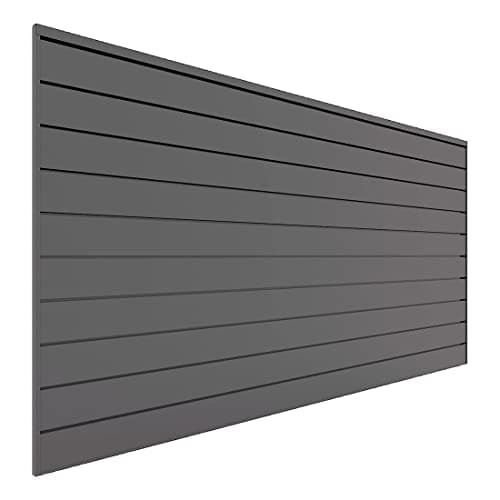 If you would rather buy than build Proslat PVC Slatwall Panels 75 lb per sq ft published, screws and dowels in the pack. | A full wall done once, on a normal stud-framed garage | 75 lb / sq ftInstall doc | |
| 2 | 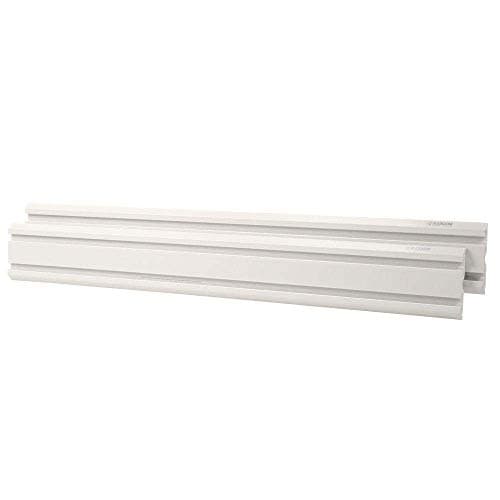 Closest to a cleat in shape Gladiator 4' GearTrack Channels (2-Pack) A horizontal rail rather than a panel field, 75 lb per linear foot. | Heavy single items — bikes, ladders, wheelbarrows — on a stud wall | 75 lb / linear ftManufacturer | |
| 3 | 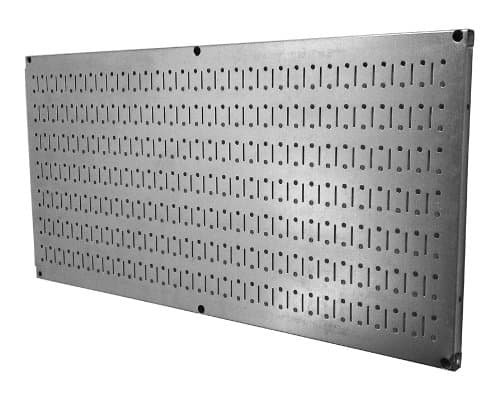 The cheap manufactured option Wall Control 16in x 32in Metal Pegboard Panel Metal pegboard, published rating, no saw required. | Hand tools you want to rearrange often, on any wall | 200 lb / panelInstall doc | |
| 4 | 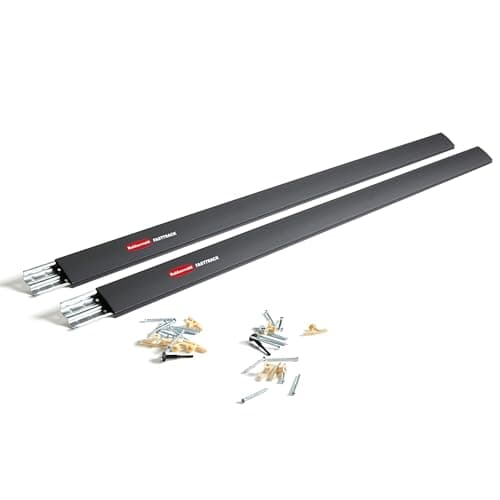 Cheapest rail Rubbermaid FastTrack Garage Rail 1,750 lb rail into studs, but hooks are rated 25 to 50 lb each. | Hanging long-handled tools and bikes off a rail rather than a panel | 1,750 lb totalInstall doc |
#ad We earn a commission if you buy through this link, at no extra cost to you. How this site is funded. Prices last checked October 22, 2026.
Every other wall system on this site arrives with a number attached. Proslat publishes 75 lb per square foot. Gladiator publishes 50 for its panel and 75 per linear foot for its channel. Rubbermaid publishes 1,750 lb for a rail and 50 lb for the hooks that hang on it. Each of those numbers has a manufacturer behind it who has decided what they are prepared to stand behind.
A French cleat wall has none. Not a low one — none. There is no manufacturer, no spec sheet, no warranty and no published figure, and every confident capacity claim you will read about cleat walls is somebody’s arithmetic rather than a tested rating. That is worth saying out loud on a site whose whole argument is about published figures, and it cuts both ways.
How the load actually travels
The mechanism is the appeal. A cleat ripped at 45 degrees and fixed to the wall points its bevel up and out; the mating cleat on the shelf or cabinet points down and in. Hang one on the other and the weight pulls the item into the wall rather than off it. A hook on a pegboard is loaded in shear and tries to lever out; a cleat is loaded in bearing and tries to clamp itself tighter.
That geometry is why a cleat wall genuinely can outperform a manufactured panel per dollar. The load path is short and direct: item, cleat, screw, stud. There is no proprietary hook, no plastic panel between the load and the framing, and no bracket depending on a slot profile.
Comparison of the two approaches on the axes that decide the purchase. Panel figures are the published manufacturer ratings cited elsewhere on this site.
| French cleat wall | Manufactured panel | |
|---|---|---|
| Published load rating | Not published — no manufacturer exists | 50–75 lb / sq ft |
| Load path | Item → cleat → screw → stud | Item → hook → panel → fastener → stud |
| Cost per square foot | A sheet of plywood and screws | Several times that |
| Tools required | Table saw or track saw set to 45 degrees, stud finder, drill | Drill and a level |
| Warranty | Not published — none | 1 to 20 years depending on brand |
| Accessories | You make them, which is the point and the cost | Bought, and locked to the brand |
What you are actually buying
A cleat wall is not a cheap version of slatwall. It is a different product with a different job. Slatwall and pegboard are for hanging many small things at arbitrary positions: hooks go anywhere, and rearranging is instant. A cleat wall is for hanging fewer, heavier, bespoke things: a shelf you built, a tool holder shaped to a specific tool, a cabinet.
The corollary is the hidden cost. Every manufactured system comes with an accessory range you can buy on a Tuesday. A cleat wall comes with nothing, and each holder has to be built. People who love cleat walls love that; people who wanted their garage finished this month do not. Be honest with yourself about which one you are before you buy the plywood.
Practical build notes
Cleat angle. Forty-five degrees is the convention and there is no reason to deviate. A shallower angle holds less securely; a steeper one makes the mating piece fragile at the tip.
Plywood over solid timber. Plywood’s cross-laminated plies resist splitting along the bevel, which is exactly where a solid-wood cleat fails. Use a good-quality sheet; the cheap sheathing grades have voids that end up in the bevel.
Spacing. Run cleats horizontally at a spacing that suits what you own rather than a rule from a video. Closer spacing gives more placement options and uses more plywood. Most garages settle somewhere around a hand’s width to a foot apart.
Run them full width. The advantage of the system is horizontal freedom, and a cleat that stops halfway across the wall throws that away. Full-width runs also mean every cleat crosses several studs, which is where the capacity comes from.
When to buy a system instead
Proslat PVC Slatwall Panels
Proslat · PVC Slatwall
#ad We earn a commission if you buy through this link, at no extra cost to you. How this site is funded. Prices last checked October 22, 2026.
The default PVC slatwall, and the one whose documentation actually tells you how to hit the rating: 1-1/2 inch #8 pan head screws into studs at 16 inch spacing. The 75 lb per square foot figure is published without a load distance, so treat it as a flat-against-the-wall number.
- Load distance:
- not stated by the manufacturer, so treat the figure as a flat-against-the-wall number
- Fastening:
- 1-1/2" #8 pan head screws, studs at 16" spacing
Proslat states the fastener and the stud spacing, which most of this category does not. It does not state a load distance.
- Published rating
- 75 lb / sq ftInstall doc
- Dimensions
- 8 ft x 4 ft sections, 10 single slats per boxManufacturer
- Steel gauge
- Not published — this manufacturer does not state one
- Thickness
- Not published
- Material
- High-density PVCManufacturer
- Coverage
- Not published
- Warranty
- Not published
- Publishes the fastener spec and stud spacing its rating assumes
- Hidden-screw design, so the finished wall has no visible fixings
- PVC does not care about garage humidity the way MDF slatwall does
- 75 lb/sq ft is the lowest published rating of the PVC systems here
- No load distance published, so bracket-mounted shelving is unquantified
The straightforward alternative when the appeal of a cleat wall is the capacity rather than the woodworking. Proslat publishes 75 lb per square foot, names masonry substrates explicitly, and includes the installation screws and dowels in the pack, so the whole job is a drill and an afternoon.
The honest counterpoint is that a PVC panel field costs several times what a sheet of plywood costs, and its one-year warranty is shorter than storeWALL and Trusscore offer. You are paying for a published number and a weekend back.
Gladiator 4' GearTrack Channels (2-Pack)
Gladiator · GearTrack Channels
#ad We earn a commission if you buy through this link, at no extra cost to you. How this site is funded. Prices last checked October 22, 2026.
Rated 75 lb per LINEAR foot while Gladiator's own GearWall is rated 50 lb per SQUARE foot. Convert the channel's 6 inch height and the rail works out at roughly 150 lb per square foot of wall it occupies — three times the panel, from the same brand, hidden entirely by the change of unit.
- Load distance:
- not stated by the manufacturer, so treat the figure as a flat-against-the-wall number
- Fastening:
- Bare wood studs, or drywall over wood studs
Published as 'Holds up to 75 lbs. per linear foot' — a different unit from the GearWall panel sold alongside it.
- Published rating
- 75 lb / linear ftManufacturer
- Dimensions
- Not published
- Steel gauge
- Not published — this manufacturer does not state one
- Thickness
- Not published
- Material
- Not published
- Coverage
- Not published
- Warranty
- Not published
- Highest normalized capacity of any Gladiator wall product
- Mounting substrate is stated: bare studs or drywall over studs
- Shares the Gladiator accessory range with GearWall
- Rated in a unit that cannot be compared to anything else without converting it
- Covers a 6 inch band of wall, not a full panel field
If what attracts you about cleats is the horizontal-rail geometry rather than making your own holders, GearTrack is the manufactured version of the same idea: a channel that runs across the studs and carries hooks along its length, published at 75 lb per linear foot with the substrate stated.
You lose the ability to hang anything you can screw a cleat to, and gain a published rating and an accessory range. For most garages that is the better trade; for a woodworker with a saw already set up, it is not.
- You already own a table saw or track saw and enjoy using it
- What you hang is heavy, bespoke, or an odd shape no hook fits
- The budget is genuinely tight and the labor is free
- You want to be able to add a holder for anything, forever
- You want a published capacity to plan against
- The wall is masonry, where the fixing problem dominates either way
- You need it finished this weekend without a saw setup
- What you are hanging is dozens of small tools rather than a few large ones
The three-way comparison of cleats against slatwall and pegboard, with the published figures side by side, is in slatwall versus pegboard versus French cleat. If the wall is already spoken for, work out what has to stay reachable first in the wall layout guide.
Common questions
How much weight can a French cleat hold?
What angle should a French cleat be cut at?
Is a French cleat wall stronger than slatwall?
What plywood should I use for French cleats?
Do French cleats need to go into studs?
Sources
- Proslat PVC slatwall FAQ — 75 lb per square foot, masonry substrates named
- Gladiator GearTrack channels — 75 lb per linear foot, substrate stated
- Gladiator GearWall panels — 50 lb per square foot
- Rubbermaid FastTrack hang rail — 1,750 lb rail, 25-50 lb accessories
Figures were read on the dates shown against each source. If one has changed, or if we have got something wrong, tell us and we will correct the page.
Read next
- SlatwallSlatwall vs pegboard vs French cleatCost, capacity, install time, accessory lock-in and moisture behavior across all three systems in one table.
- Planning & installMounting into drywall, studs and masonryThe substrate case nobody else covers: what happens to a published rating when the wall is block rather than studs.
- Planning & installLaying out a garage wallZoning by frequency, working around the obstructions every garage has, and the test that prevents expensive mistakes.